

Afro American paintings are visual artworks created by African American artists that document cultural identity, historical experience, and creative resistance within the broader story of American art. The Smithsonian American Art Museum holds over 2,000 works by more than 200 African American artists, spanning from the early Republic to the present. That collection alone signals how deep and wide this tradition runs. Artists like William H. Johnson, Romare Bearden, and Kerry James Marshall have each pushed the form in distinct directions, making African American art one of the most layered and consequential fields in the visual arts today.
What are the key historical movements in Afro American paintings?
The history of African American art begins well before the 20th century. Robert S. Duncanson, working in the mid-1800s, produced luminous landscape paintings that placed him squarely in the Hudson River School tradition while navigating a society that denied his full humanity. His success proved that Black artistic excellence predated any institutional recognition of it.
The Harlem Renaissance, roughly 1920–1940, is the most cited turning point. Key figures like William H. Johnson and Augusta Savage used painting and sculpture to assert Black dignity at a time when American culture systematically denied it. Johnson’s bold, flat figures and vivid colors drew from both European modernism and African American folk traditions. That combination produced something entirely new.
The Civil Rights era pushed themes of protest and solidarity to the foreground. Artists began treating the canvas as a political space, not just an aesthetic one. That shift is still felt in the work of contemporary figures like Kara Walker and Mark Bradford, who use large-scale painting and mixed media to interrogate race, power, and memory.
One movement that rarely gets its due is the Florida Highwaymen. These 26 self-taught Black artists sold landscape paintings from car trunks during segregation, bypassing galleries that would not exhibit them. They were inducted into the Florida Artists Hall of Fame in 2004. Their story is a reminder that Black artists have always found ways to reach audiences, with or without institutional permission.
- Pre-Harlem era: Robert S. Duncanson and landscape painting in the 1800s
- Harlem Renaissance: William H. Johnson, Augusta Savage, and the assertion of Black identity through modernism
- Civil Rights era: Political and protest-driven painting as a form of cultural resistance
- Florida Highwaymen: Self-taught landscape artists who built a movement outside the gallery system
- Contemporary: Kerry James Marshall, Kara Walker, and Mark Bradford expanding the legacy
Pro Tip: If you are exploring Harlem Renaissance prints for your collection, look for works that reference the visual language of that era: bold color fields, figurative subjects, and scenes of Black community life.
How do Black artists paintings reflect cultural identity and social themes?
African American paintings carry meaning that extends far beyond their visual surface. The best works in this tradition function simultaneously as personal expression, cultural memory, and social commentary. That layered purpose is what separates them from purely decorative art.
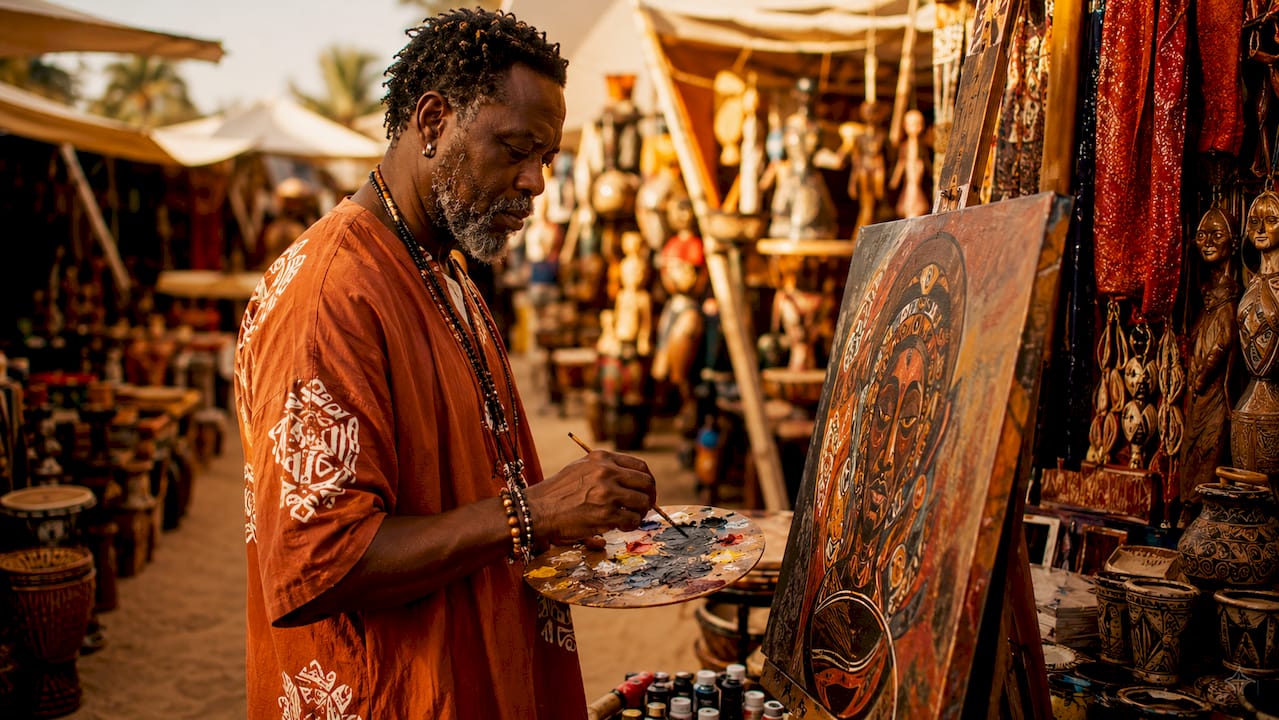
Art historian David Driskell argued for viewing Black art through diasporic perspectives rather than narrow stylistic categories. His framework reshaped how curators and collectors approach the field. It means a painting of a Black family at a Sunday dinner carries the same weight as an explicitly political work. Both are acts of cultural documentation.
Four recurring themes define much of this tradition:
- Resistance and survival: Works by Kara Walker use silhouette and shadow to confront the violence of American history without softening it.
- Family and community: Romare Bearden’s collages place Black domestic life at the center of the American story.
- Spirituality and heritage: Many artists draw directly from West African visual traditions, incorporating pattern, symbol, and color in ways that connect to the diaspora.
- Social justice: Mark Bradford layers maps, billboards, and found materials to build paintings that read as both abstract and urgently political.
“African American art is not a footnote to American art history. It is a central chapter.” — Valerie Mercer, Curator, Detroit Institute of Arts, via Observer
The ongoing tension between African cultural heritage and Western art norms continues to shape how artists make choices and how critics receive their work. That tension is not a problem to be resolved. It is the engine of the tradition’s creative power.
What styles and mediums define Afro American artistry across time?
The range of styles within African American painting is wider than most collectors expect. Portraits, landscapes, figurative works, abstraction, collage, and mixed media all have deep roots in this tradition. No single style defines it.
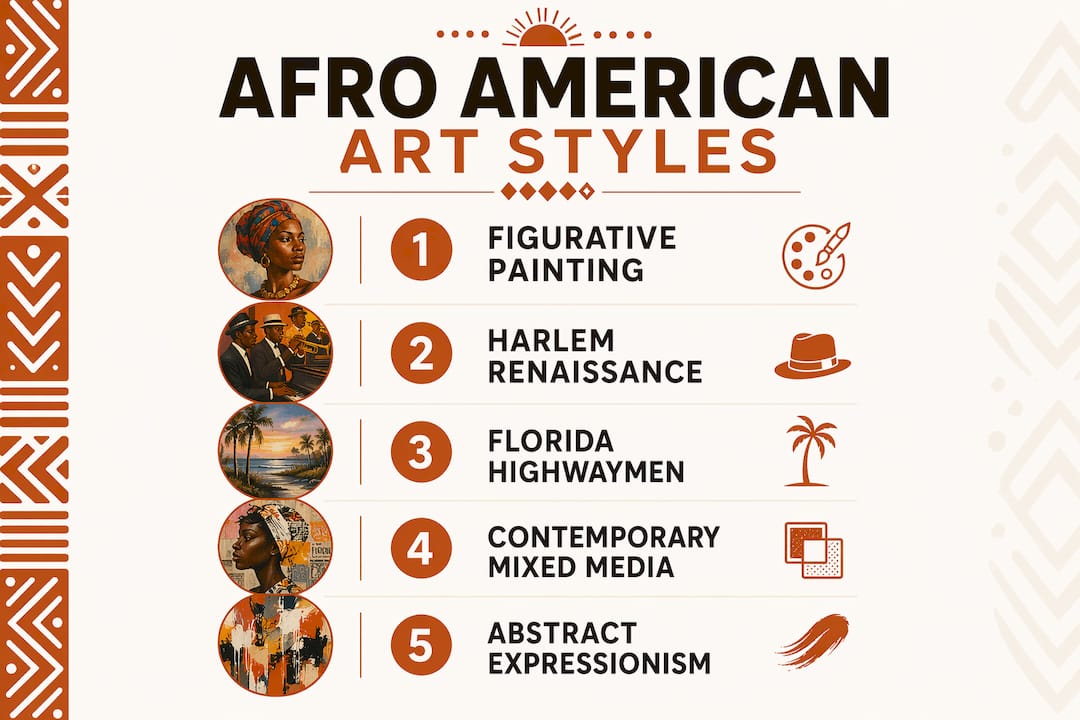
| Style or medium | Key characteristics | Representative artists |
|---|---|---|
| Figurative painting | Realistic depictions of Black subjects and daily life | William H. Johnson, Kerry James Marshall |
| Landscape painting | Natural scenes, often with emotional or symbolic weight | Robert S. Duncanson, Florida Highwaymen |
| Collage and mixed media | Layered materials combining painting with found objects | Romare Bearden, Mark Bradford |
| Abstract painting | Non-representational forms exploring identity and emotion | Norman Lewis, Sam Gilliam |
| Contemporary narrative | Large-scale works addressing race, history, and politics | Kara Walker, Amy Sherald |
The Florida Highwaymen offer one of the most instructive contrasts in the field. Their rapid, assembly-line painting style produced vivid Florida landscapes at speed, using house paint and Masonite boards. That approach stands in direct contrast to the academic training of artists like Johnson or Duncanson. Both traditions are legitimate. Both are collectible.
The Smithsonian’s collection spans all of these styles, making it the single best free resource for understanding the visual range of African American painting across centuries.
Pro Tip: When evaluating a piece for your collection, consider how the contemporary Black art styles it draws from connect to the historical tradition. A work that consciously references the Harlem Renaissance or the Florida Highwaymen carries additional cultural depth.
How can collectors engage with and acquire African American paintings?
Collecting African American art requires the same rigor as collecting any serious art, plus an additional layer of cultural literacy. The field has historically been undervalued by mainstream institutions, which means significant works can still be found at accessible price points. That window is narrowing as institutional recognition grows.
Provenance is the first priority. Collectors prioritize exhibition history and museum-verified records when valuing works. The landmark 1976 exhibition Two Centuries of Black American Art, curated by David Driskell, remains a key reference point for authenticating historically significant pieces. If a work appeared in that show or in subsequent major exhibitions, its provenance is well-documented.
Museum databases like the Smithsonian American Art Museum’s online catalog are free and reliable starting points for researching any artist before you buy. The Detroit Institute of Arts, under curator Valerie Mercer, is actively acquiring works to address historical gaps in their collection. Tracking what major institutions are buying tells you where scholarly and market attention is moving.
- Start with museum archives: The Smithsonian’s free online database covers artists across multiple centuries and styles.
- Verify exhibition history: Works connected to landmark shows carry stronger provenance and cultural significance.
- Buy from trusted sources: Reputable galleries, established auction houses, and curated online platforms reduce authentication risk.
- Study authentication markers: For self-taught artists like the Florida Highwaymen, signatures and creation periods are now closely scrutinized. Original pieces originally sold for as little as $25, which means the market for fakes exists.
- Consider archival prints: Museum-grade reproductions from trusted platforms let you build a meaningful collection at accessible price points while supporting living artists.
Key takeaways
African American paintings form a central, not peripheral, chapter of American art history, and collecting them demands both cultural literacy and rigorous provenance research.
| Point | Details |
|---|---|
| Deep historical roots | The tradition spans from Robert S. Duncanson in the 1800s through contemporary artists like Kerry James Marshall. |
| Institutional recognition is growing | Museums like the Smithsonian and Detroit Institute of Arts are actively expanding their African American collections. |
| Style diversity is defining | Figurative, landscape, abstract, and mixed media all have strong roots in this tradition. |
| Provenance drives value | Exhibition history, especially ties to landmark shows like Two Centuries of Black American Art, authenticates significant works. |
| Collecting entry points exist | Archival prints and curated online platforms offer accessible ways to build a culturally meaningful collection. |
Why I think the conversation around these paintings is finally changing
I have watched the institutional conversation around African American painting shift more in the last decade than in the previous three combined. Museums that once treated this work as a specialty category are now placing it at the center of their American art narratives. That is not a small thing. It reflects a genuine reckoning with what American art actually is.
What I find most interesting is the resistance to narrow categorization. David Driskell spent decades arguing that Black art should be understood through diasporic and global lenses, not just as a response to American racism. That argument has won. You see it in how curators write wall text, in how auction houses frame lots, and in how collectors talk about what they are building.
The artists doing the most compelling work right now, people like Amy Sherald and Titus Kaphar, are not waiting for permission to occupy the center of American art. They are already there. The collectors who recognize that early are building collections that will matter. The ones who still treat this as a niche are going to look back and wonder what they missed. Explore Black heritage wall art to see how contemporary artists are carrying this tradition forward.
— Robert
Discover African American art prints at Melaninart
Melaninart is a Black-owned platform built specifically for collectors and art lovers who want to bring authentic African American artistry into their spaces. Every piece in the catalog originates from original oil or watercolor paintings by artist Robert Lawrence, reproduced as museum-grade archival prints. The collection covers Afrocentric art, Afrofuturism, and Harlem Renaissance themes, with customizable framing and sizing options. If you are ready to own a piece of this tradition, start with Shine On, Ancestors, or Unbothered. Each one is a direct expression of the cultural legacy this article covers.
FAQ
What defines Afro American paintings as a category?
Afro American paintings are visual artworks created by African American artists that reflect Black cultural identity, historical experience, and artistic expression. The category spans centuries and includes figurative, landscape, abstract, and mixed media works.
Who are the most influential Black painters in American art history?
William H. Johnson, Romare Bearden, Robert S. Duncanson, Kerry James Marshall, and Kara Walker are among the most studied and collected figures in African American painting.
How do I verify the authenticity of an African American painting?
Check the artist’s exhibition history against major institutional records, including the Smithsonian American Art Museum’s free online database, and look for ties to landmark exhibitions like Two Centuries of Black American Art from 1976.
What were the Florida Highwaymen?
The Florida Highwaymen were 26 self-taught Black artists who sold landscape paintings from car trunks during segregation. They were inducted into the Florida Artists Hall of Fame in 2004 and their works are now actively collected and authenticated.
Are archival prints a legitimate way to collect African American art?
Museum-grade archival prints from trusted platforms are a recognized and accessible entry point for collectors. They preserve the visual integrity of original works and support living artists and Black-owned businesses directly.