

African abstract art did not simply influence European modernism. It unlocked it. When Pablo Picasso, Henri Matisse, and Amedeo Modigliani encountered West African masks in Paris museums during the early 1900s, they did not just borrow stylistic details. They absorbed an entirely different logic of representation, one that African artists had developed over centuries. Understanding abstract art African traditions as foundational, rather than peripheral, changes everything about how we read modern art history.
Table of Contents
- Key takeaways
- What African abstract art looked like before Picasso
- How European artists encountered African abstraction
- Reframing African art as the foundation, not the footnote
- Contemporary African abstract artists carrying the legacy forward
- My take on why this reframing matters now
- Bring African abstraction into your space
- FAQ
Key takeaways
| Point | Details |
|---|---|
| African abstraction came first | Geometric distortion and flattened form were established African art styles long before Cubism existed. |
| Picasso copied, African artists created | Cubism’s core visual language was directly derived from Fang and Dan mask traditions, not invented by Europeans. |
| African artists asserted originality | Artists like Rufus Ogundele explicitly rejected European modernist labels, insisting on their own cultural authorship. |
| Contemporary artists carry the legacy | Owanto and Njideka Akunyili Crosby continue evolving African abstraction as a living, cosmopolitan practice. |
| Institutions are shifting the narrative | Major museums like Tate Modern now actively challenge the misconception that African art is limited to ethnographic objects. |
What African abstract art looked like before Picasso
Long before European modernists declared that breaking with realism was radical, African artists across West and Central Africa had already built sophisticated systems of abstraction. The Fang people of present-day Gabon created masks with exaggerated brow ridges, compressed facial planes, and geometric symmetry that had nothing to do with visual accuracy. They were not trying to depict a face. They were encoding cosmological meaning.
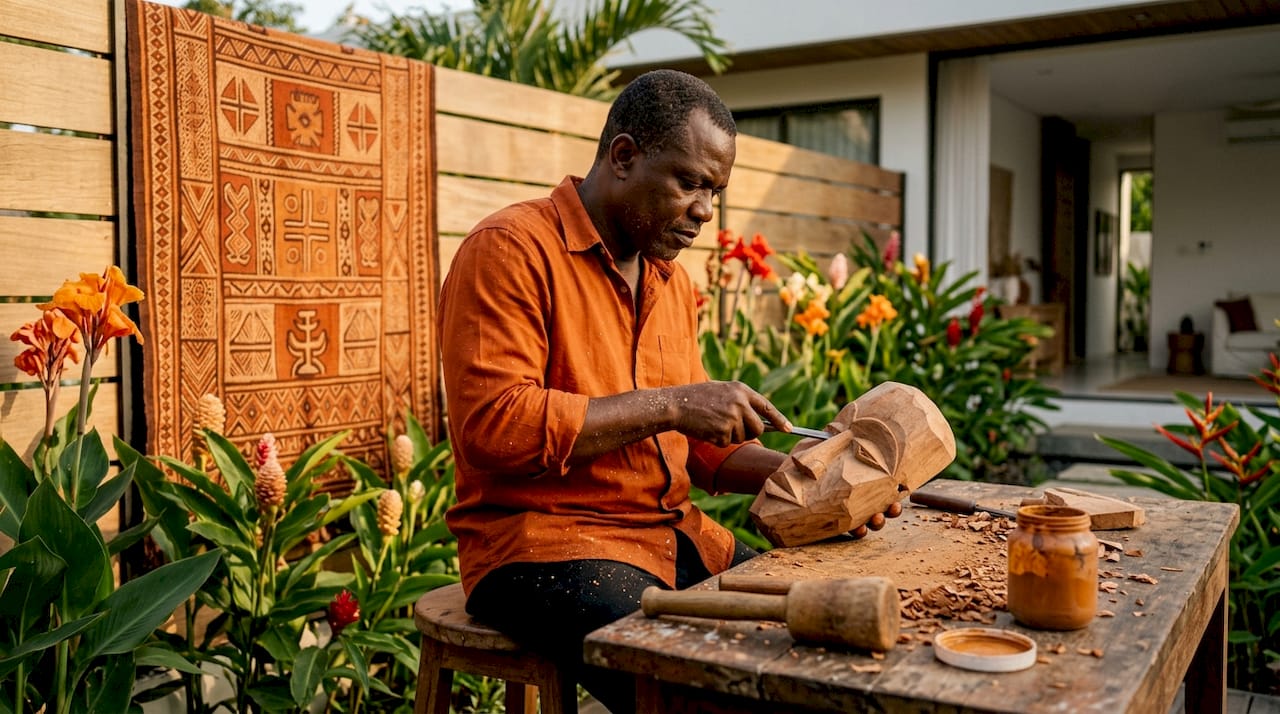
The Dan people of Ivory Coast took a different approach, producing masks with smooth, idealized forms that distorted natural proportions in favor of spiritual expression. Both traditions treated the human form as a symbol to be reorganized, not a likeness to be copied. That is the definition of abstraction.
Key characteristics of these pre-modernist African abstract styles included:
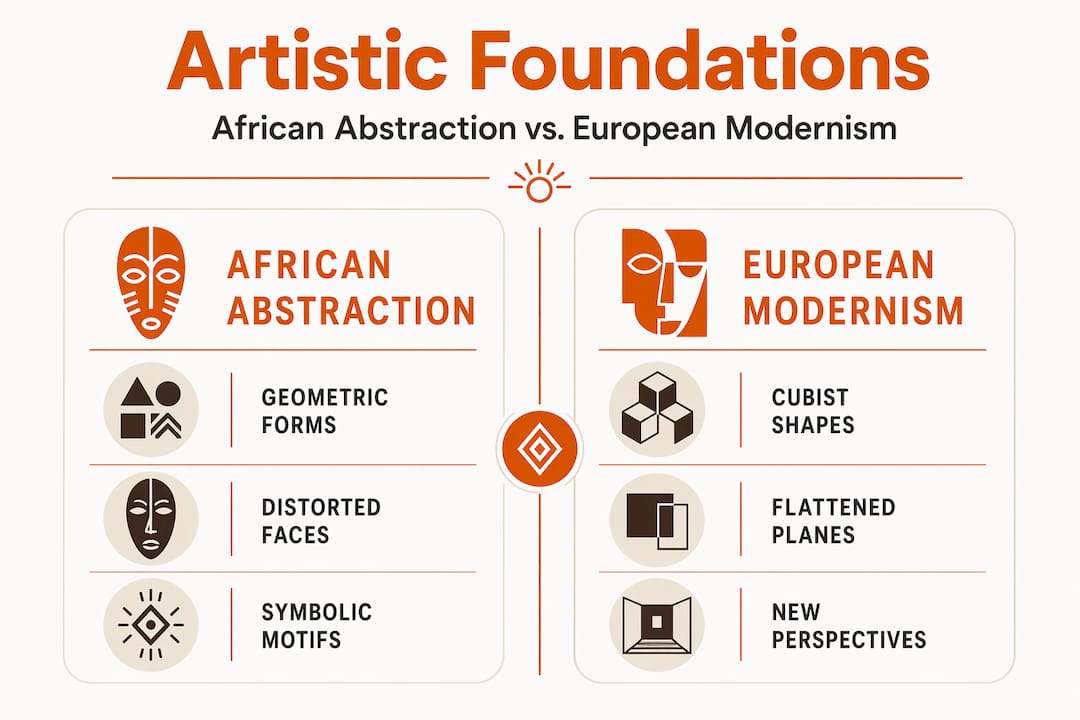
- Fragmentation of form: Features like eyes, nose, and mouth were repositioned to convey spiritual hierarchy rather than anatomical accuracy.
- Flattening of planes: Three-dimensional faces were reduced to angular, two-dimensional compositions that emphasized structure over depth.
- Symbolic geometry: Repeated patterns, triangles, and lines carried specific cultural and cosmological meanings tied to ancestral belief systems.
- Embodied function: Masks were not decorative objects. They were conduits linking realms between the living and the ancestral world.
Nigerian artist Rufus Ogundele represents one of the most striking examples of this tradition meeting formal training. He synthesized Yoruba cultural beliefs with European printmaking techniques, yet rejected modernist labels entirely. His declaration, “Rufus is Rufus,” was not arrogance. It was a precise statement about artistic authorship.
Pro Tip: When studying traditional African abstract art, look past the object and ask what the distortion is communicating. Every geometric choice encodes a belief system, not a design preference.
How European artists encountered African abstraction
Paris in the early 1900s was full of African objects that French colonizers had brought back from West and Central Africa. Museums like the Trocadéro displayed Fang reliquary figures and Dan masks as anthropological specimens, not art. Picasso visited these collections and was, by his own account, changed permanently.
What he saw was not primitive decoration. He saw a completely different permission structure for making images. African masks inspired Cubism’s flattened planes and deliberate distortions of the human body. The same visual logic, developed by African artists over centuries, became the foundation for what Europeans later called a revolutionary break from tradition.
Here is how that visual transfer actually worked:
- Picasso’s “Les Demoiselles d’Avignon” (1907): The two right-side figures in this painting directly reference African mask forms. Their faces are angular, fragmented, and spatially dislocated. This was not coincidence. Picasso repainted those figures after visiting the Trocadéro.
- Matisse and pattern as structure: Matisse absorbed the West African use of repeated pattern and bold color contrast as compositional tools rather than decorative afterthoughts. His interiors reflect this directly.
- Modigliani’s elongated forms: His stretched figures echo the vertical proportions common in African sculptural traditions, particularly masks from the Baule people of Ivory Coast.
| Visual Element | African Origin | European Modernist Adoption |
|---|---|---|
| Flattened facial planes | Fang reliquary masks | Cubist portraiture (Picasso) |
| Geometric fragmentation | Dan ceremonial masks | Analytical Cubism |
| Repeated pattern as structure | Kente and textile traditions | Matisse’s decorative interiors |
| Elongated vertical proportion | Baule sculptural tradition | Modigliani’s figure studies |
Reframing African art as the foundation, not the footnote
The standard art history narrative goes like this: African art influenced Picasso, who then invented Cubism. That framing has one serious problem. It assigns authorship to the student and erases the teacher.
African artists gave European modernists something specific: permission. Permission to abandon the realist conventions that had dominated European painting since the Renaissance. That permission was not abstract advice. It was a fully realized visual vocabulary, centuries in the making, that Europeans encountered, absorbed, and repackaged as their own discovery.
“It doesn’t look ‘African’” is exactly the kind of statement that reveals how deep the misunderstanding runs. When African abstraction is sophisticated, geometric, and conceptually complex, Western viewers assume it must have been influenced by Europe. The actual history runs in the opposite direction.
Curatorial institutions are beginning to correct this. Tate Modern’s 2026 exhibitions focus specifically on African modernism and abstraction, designed to dismantle the assumption that African art exists only in the category of masks and ritual objects. The reframing matters because:
- It restores credit to the African artists and communities who developed these visual systems.
- It challenges collectors and curators to reassess provenance and intellectual ownership in their acquisitions.
- It expands what counts as “fine art” in institutional contexts where African work has historically been cataloged as ethnography.
- It positions contemporary African abstract artists as heirs to a major foundational tradition, not practitioners of a regional style.
Contemporary African abstract artists carrying the legacy forward
The story does not end in 1907. African abstraction is a living practice, and the artists extending it today are some of the most globally recognized figures working in contemporary art.
Owanto, a Gabonese artist, treats abstraction as embodied practice rooted in ancestral cosmology rather than image-making. Her totemic sculptures and layered installations create environments where form becomes presence. She is not referencing African tradition. She is continuing it.
Njideka Akunyili Crosby works differently. Her hybrid photo-transfer and collage method challenges the binary between ethnographic African art and luxury Western abstraction. Her paintings insist that African modernity is self-aware, cosmopolitan, and intimate at the same time. African modernism today reflects migration, media saturation, and global conversations, not an isolated regional tradition.
The market reflects this reality. Gallery benchmarks for Nigerian modernists have reached $75,000 in recent sales as of May 2026, signaling serious global collector interest in African abstraction.
| Artist | Approach | Key Contribution |
|---|---|---|
| Rufus Ogundele | Yoruba abstraction meets printmaking | Asserted African originality against modernist labels |
| Owanto | Totemic layering and cosmological presence | Treats abstraction as ancestral embodiment |
| Njideka Akunyili Crosby | Photo-transfer, collage, diaspora identity | Redefines African modernity as cosmopolitan and layered |
Pro Tip: When collecting contemporary African abstract art, look for artists who reference specific cultural systems rather than generic “African” aesthetics. That specificity is where the intellectual depth and long-term value both live.
My take on why this reframing matters now
I’ve spent years thinking about why certain art histories get told and others get buried. What I keep coming back to is that the erasure of African abstraction’s foundational role was not accidental. It was convenient. Crediting Picasso with inventing modernism is a cleaner story for institutions that built their prestige on European masters.
But here is what I find genuinely striking: the African artists who developed these visual systems never needed European validation to know what they had. Rufus Ogundele said “Rufus is Rufus.” Owanto grounds her work in ancestral cosmology without footnoting Western art theory. These artists did not wait for the Tate to acknowledge them. They just kept building.
For collectors and historians, the practical implication is clear. If you understand that African abstraction is foundational rather than derivative, you read the entire canon differently. You also recognize that acquiring African abstract art today is not a trend. It is a correction.
— Robert
Bring African abstraction into your space
If this history has shifted how you see modern art, the next step is living with it. Melaninart carries a curated collection of Afrocentric art prints that bring the visual intelligence of African abstraction into your home with museum-grade quality. Each piece is reproduced from an original oil or watercolor painting, framed to your specifications, and built to last. You can also explore the Afrofuturism collection for work that connects African visual traditions to contemporary and forward-looking expression. This is art with a history worth knowing and a presence worth owning.
FAQ
What is African abstract art?
African abstract art refers to visual traditions across the African continent that distort, fragment, or geometrize natural forms to communicate spiritual, cosmological, or cultural meaning rather than achieve visual realism. It predates European abstraction by centuries.
How did African art influence Picasso and Cubism?
Picasso encountered West African masks at the Trocadéro museum in Paris around 1907 and directly incorporated their flattened planes and geometric distortion into works like “Les Demoiselles d’Avignon,” which became a cornerstone of Cubism.
Who are the most important contemporary African abstract artists?
Owanto and Njideka Akunyili Crosby are two of the most recognized contemporary African abstract artists working today. Both extend African abstraction philosophically and formally while engaging with global art conversations.
Why does it matter whether African art “influenced” or “founded” European modernism?
The distinction assigns authorship correctly. Framing African art as an influence credits Europeans with the invention. Recognizing it as foundational acknowledges that African artists developed a complete visual language that Europeans adopted, which is both historically accurate and essential for fair representation in art history.
What African art styles did European modernists borrow from?
European modernists primarily drew from Fang reliquary masks, Dan ceremonial masks, and Baule sculptural traditions, adopting their fragmented facial planes, geometric patterning, and vertical proportional distortions.