

Black art is frequently reduced to a single story, one where every brushstroke is assumed to be a political statement and every canvas a protest sign. That assumption misses something far more important. The power of Black art lies in its capacity to hold complexity, to express joy alongside grief, community alongside solitude, and personal memory alongside collective history. For collectors and art lovers who want to move beyond surface-level appreciation, understanding how lived experience shapes Black art is not just useful. It is transformative.
Table of Contents
- How major art movements shaped Black lived experience in art
- Redefining identity and experience through art: The Harlem Renaissance
- Narrative, abstraction, and materials: How art encodes history
- Beyond racial representation: Nuance and expert perspectives
- Practical ways to appreciate the reflection of lived experience
- Our perspective on appreciating Black lived experience through art
- Discover and collect art that reflects Black lived experience
- Frequently asked questions
Key Takeaways
| Point | Details |
|---|---|
| Art reflects lived experience | Black artistry centers personal and communal histories, making art a vessel for nuance and identity. |
| Themes are multidimensional | Black art explores justice, joy, resilience, and heritage—often simultaneously, beyond surface definitions. |
| Method matters | Narrative and abstraction, plus unique material choices, are crucial for encoding history and emotion in art. |
| Avoid interpretive traps | Reducing Black art to racial themes limits understanding and misses the artists’ broader conceptual intentions. |
| Collectors can engage deeply | Reading theme, structure, and material offers a practical framework for appreciating Black lived experience in art. |
How major art movements shaped Black lived experience in art
To understand Black art today, you have to look at the movements that gave it structure, language, and purpose. Two stand above the rest in terms of their lasting influence on how lived experience is expressed and interpreted.
The Black Arts Movement (roughly 1965 to 1975) was a cultural revolution that ran parallel to the civil rights and Black Power movements. Artists, poets, and musicians rejected the idea that Black creativity needed to conform to European standards of beauty or value. They insisted that Black art should speak directly to Black communities, address real political conditions, and serve as a tool for self-determination. As the National Gallery of Art explains, major Black art movements institutionalize this reflection of lived experience by making art explicitly linked to civil rights, Black history, identity, and self-determination. That was a radical and necessary shift.
The Harlem Renaissance (roughly 1920 to 1940) arrived decades earlier but planted many of the same seeds. It was a flowering of Black intellectual, artistic, and cultural life centered in New York City, though its influence spread far beyond. Artists used visual art to counter the degrading caricatures that mainstream American culture had long used to define Black people.
| Movement | Main themes | Impact on lived experience |
|---|---|---|
| Harlem Renaissance | Identity, beauty, complexity, community | Countered stereotypes; created self-authored representation |
| Black Arts Movement | Self-determination, civil rights, Black Power | Politicized art; tied creativity directly to liberation |
| Contemporary Black Art | Intersectionality, joy, memory, global diaspora | Expanded scope beyond race to full human experience |
“Black art is not a monolith. It is a living archive of individual voices, collective memory, and cultural resilience.”
Both movements proved that art could do more than decorate walls. It could reshape how an entire people saw themselves. Collectors who understand this context will find that works like the Harlem Renaissance quartet prints carry layers of meaning that go far deeper than their visual beauty.
Redefining identity and experience through art: The Harlem Renaissance
The Harlem Renaissance deserves its own focused look because its contribution to self-representation was genuinely groundbreaking. Before this period, Black Americans were largely depicted in art by people outside their communities, and those depictions were almost always reductive, demeaning, or flat.
Visual artists in this era changed that entirely. As National Geographic’s history coverage documents, Black visual artists helped redefine Black identity by creating work that responded to stereotypes and asserted Black complexity and self-authored representation. That phrase, “self-authored,” is key. These were not outsiders imagining Black life. These were people painting what they actually knew and lived.
Here is how Harlem Renaissance artists challenged dominant narratives:
- They depicted ordinary life with dignity. Scenes of everyday Black life, families, street corners, music halls, were rendered with the same care and artistry that European painters gave to royalty and mythology.
- They celebrated beauty on their own terms. Rather than conforming to European beauty standards, artists like Aaron Douglas and Lois Mailou Jones created figures that were unmistakably, proudly Black.
- They built a visual vocabulary for the diaspora. By drawing on African artistic traditions alongside American experiences, they created a new visual language that spoke to a global Black audience.
| Artist | Iconic work | Impact |
|---|---|---|
| Aaron Douglas | Aspects of Negro Life | Merged African motifs with modernism; defined Harlem Renaissance visual style |
| Lois Mailou Jones | Les Fétiches | Blended African and French influences; challenged racial and gender barriers |
| Jacob Lawrence | The Migration Series | Documented the Great Migration through narrative panels; brought Black history to mainstream museums |
| Augusta Savage | Sculptural portraits of Harlem residents | Humanized and celebrated everyday Black figures |
“The Harlem Renaissance was not just an artistic movement. It was an act of collective self-definition at a moment when the world was trying to define Black people for them.”
The music and visual arts of this era were inseparable. Works like the Harlem Renaissance music prints capture that electric intersection of sound and image that defined the period.
Narrative, abstraction, and materials: How art encodes history
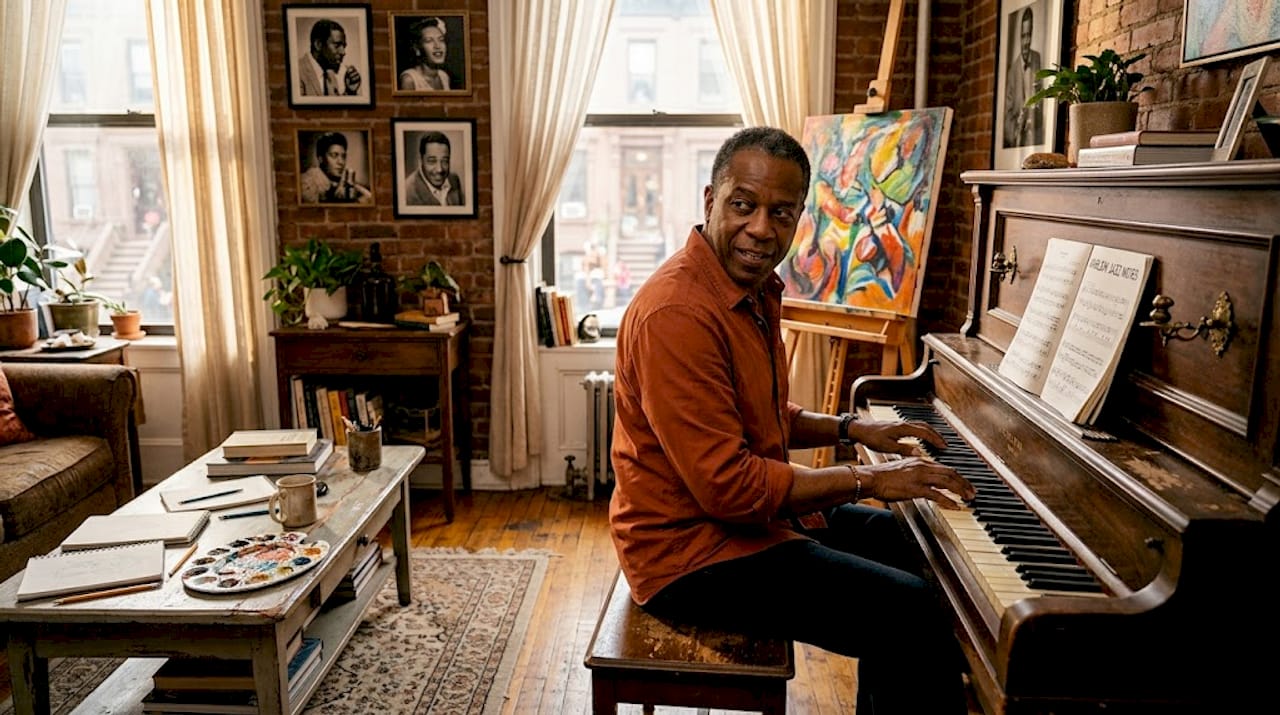
From the representational power of the Harlem Renaissance, let’s look at the technical and conceptual methods Black artists use to encode history and lived experience into their work. This is where art appreciation gets genuinely exciting.
Lived experience shows up in Black art through methodologically diverse practices: narrative, abstraction, and material strategies that encode histories such as race, labor, and violence. Each of these approaches works differently, but all of them invite the viewer to engage with something real.
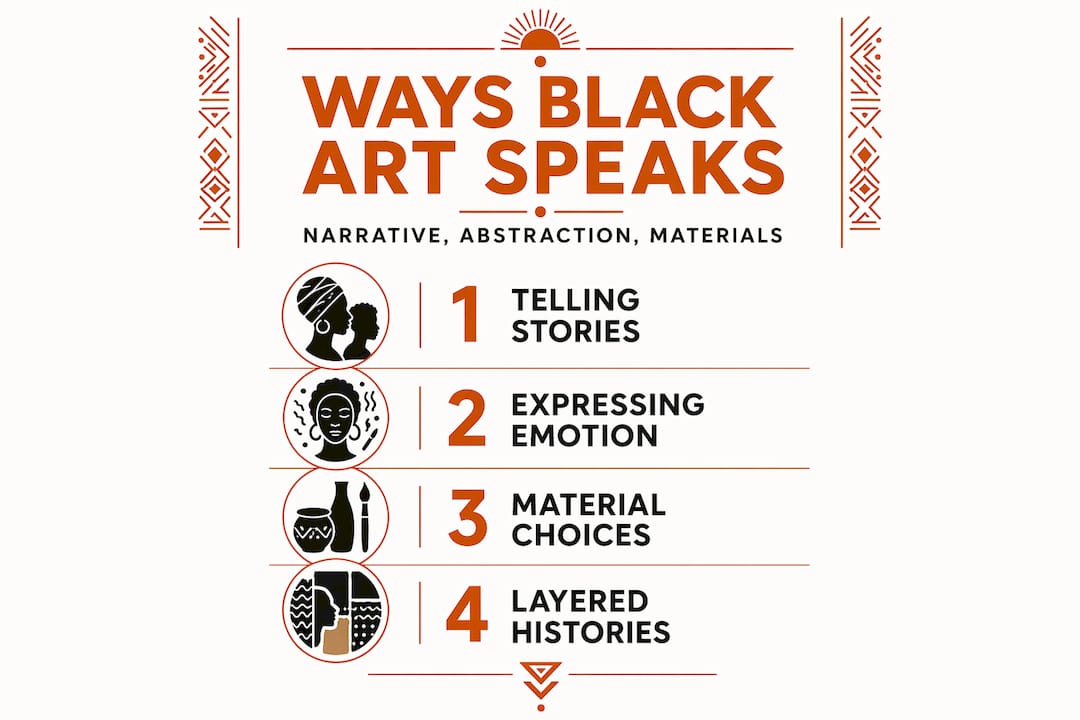
Narrative art tells stories. It might depict a specific historical event, a family moment, or a community ritual. The story is visible on the surface, but the emotional weight comes from knowing the context. A painting of a mother braiding her daughter’s hair is not just a domestic scene. It is a record of a practice passed down through generations, a form of love, and a cultural tradition with roots in Africa.
Abstract art works differently. It uses color, form, texture, and symbol to evoke emotion and history without depicting it literally. An artist might use chains of red and gold to suggest both royal African heritage and the violence of slavery, without showing either directly. The viewer brings their own knowledge and feeling to complete the meaning.
Material choices are often the most overlooked layer. Sculptor Melvin Edwards, for example, used industrial steel chains and tools in his work, materials directly associated with Black labor and bondage, to create sculptures that carry that history in their physical substance. You can also explore this idea through the artistry of African American ancestry, which traces how craft traditions and material cultures connect Black American art to its African roots.
Key things to look for when engaging with Black art:
- Subject matter: Who or what is depicted, and what is their relationship to Black history or community?
- Color palette: Are colors symbolic? Warm golds and earth tones often evoke Africa and heritage. Blues and grays can signal melancholy or resilience.
- Texture and material: Is the surface smooth or rough? Does the material itself carry historical meaning?
- Composition: Is the figure centered and powerful, or fragmented? How does the structure shape the emotional experience?
Works like the African American joy canvas art and the Black man beard canvas art reward this kind of layered looking.
Pro Tip: When you encounter a piece of Black art, resist the urge to immediately categorize it. Sit with it. Ask what the artist chose to include and what they chose to leave out. Those choices are where the meaning lives.
Beyond racial representation: Nuance and expert perspectives
After considering artistic methods, it is important to address a persistent risk in how people approach Black art: the tendency to reduce it entirely to racial themes.
The relationship between Blackness and art is not always straightforward. A persistent expert nuance is that reducing Black art to only what is “racially representative” can distort interpretation and ignore artists’ broader formal or conceptual aims. In other words, when you walk up to a painting by a Black artist and immediately ask “what is this saying about race?”, you may be missing the point entirely.
Many Black artists work with themes of geometry, color theory, spirituality, mythology, or pure formal experimentation. Their Blackness informs their perspective, but it does not dictate their subject matter. Assuming otherwise is a form of flattening that denies Black artists the full range of human creative ambition.
Common misunderstandings collectors should avoid:
- Assuming every Black artwork is a protest. Joy, beauty, and play are just as valid and just as political as anger or resistance.
- Expecting a single “Black experience.” Black artists come from dozens of countries, cultural traditions, and personal histories. There is no single story.
- Overlooking formal qualities. Composition, brushwork, and color are not secondary to meaning. They often are the meaning.
- Projecting your own interpretation without research. The artist’s stated intent and cultural context matter enormously.
Works like the Black man reading canvas art and Black love canvas art illustrate this beautifully. They are not making arguments. They are affirming presence, intimacy, and intellectual life as worthy of artistic attention.
Practical ways to appreciate the reflection of lived experience
To bring these insights into practice, here is a concrete framework for collectors and enthusiasts who want to engage more deeply with Black art.
One high-yield approach for appreciating lived experience in Black art is to read how the work produces meaning across three dimensions: theme (justice, identity, joy), structure (narrative versus abstraction), and material choices (industrial labor, found objects, craft traditions).
Here is how to apply that framework:
- Observe first, interpret second. Spend at least two full minutes looking at the work before you form any opinion. Notice what draws your eye, what feels uncomfortable, what feels warm.
- Identify the theme. Is the work celebrating something? Mourning something? Questioning something? The emotional register is often the clearest entry point.
- Examine the structure. Is the composition tight and controlled, or loose and expressive? Does the artist use realistic representation or abstraction? Each choice shapes the viewer’s experience differently.
- Research the artist. Even a five-minute search can reveal the cultural context, personal history, and artistic influences that unlock a work’s deeper meaning.
- Connect to your own experience. Great art speaks across distance. Ask yourself what in the work resonates with something you have felt or witnessed, even if the specific cultural context is unfamiliar.
Works like the Black children playing canvas art are perfect for practicing this approach. The subject is joyful and immediate, but the layers of meaning around childhood, freedom, and community run deep.
Pro Tip: Keep a simple art journal. After engaging with a piece, write three words for what you felt, one question you still have, and one thing you noticed about the artist’s technique. Over time, this builds genuine visual literacy.
Our perspective on appreciating Black lived experience through art
Here is something we have learned that most art guides will not tell you: the most rewarding appreciation of Black art does not come from knowing the most. It comes from being willing to be changed by what you see.
There is a temptation, especially for collectors building a culturally intentional collection, to approach Black art as a checklist. One piece about the civil rights era, one about African heritage, one about contemporary joy. That approach produces a collection that looks diverse on the surface but feels hollow underneath. You end up with labels, not connections.
The artists whose work genuinely moves people are the ones who resist easy categorization. They are painting from a specific, irreducible personal experience that also happens to resonate universally. When you encounter a piece like that, something in the African American joy series for example, you are not just looking at a cultural artifact. You are in conversation with another human being’s inner life.
That requires humility. It requires you to hold your assumptions loosely and let the work correct you. It means accepting that you will not always understand everything immediately, and that is not a failure. That is the beginning of real appreciation.
The collectors who build the most meaningful relationships with Black art are the ones who keep asking questions, who return to pieces they thought they understood and find new layers, and who treat each work as an ongoing conversation rather than a closed statement.
Discover and collect art that reflects Black lived experience
The history, methods, and perspectives covered in this article are not abstract. They live inside specific works of art, waiting to be experienced directly.
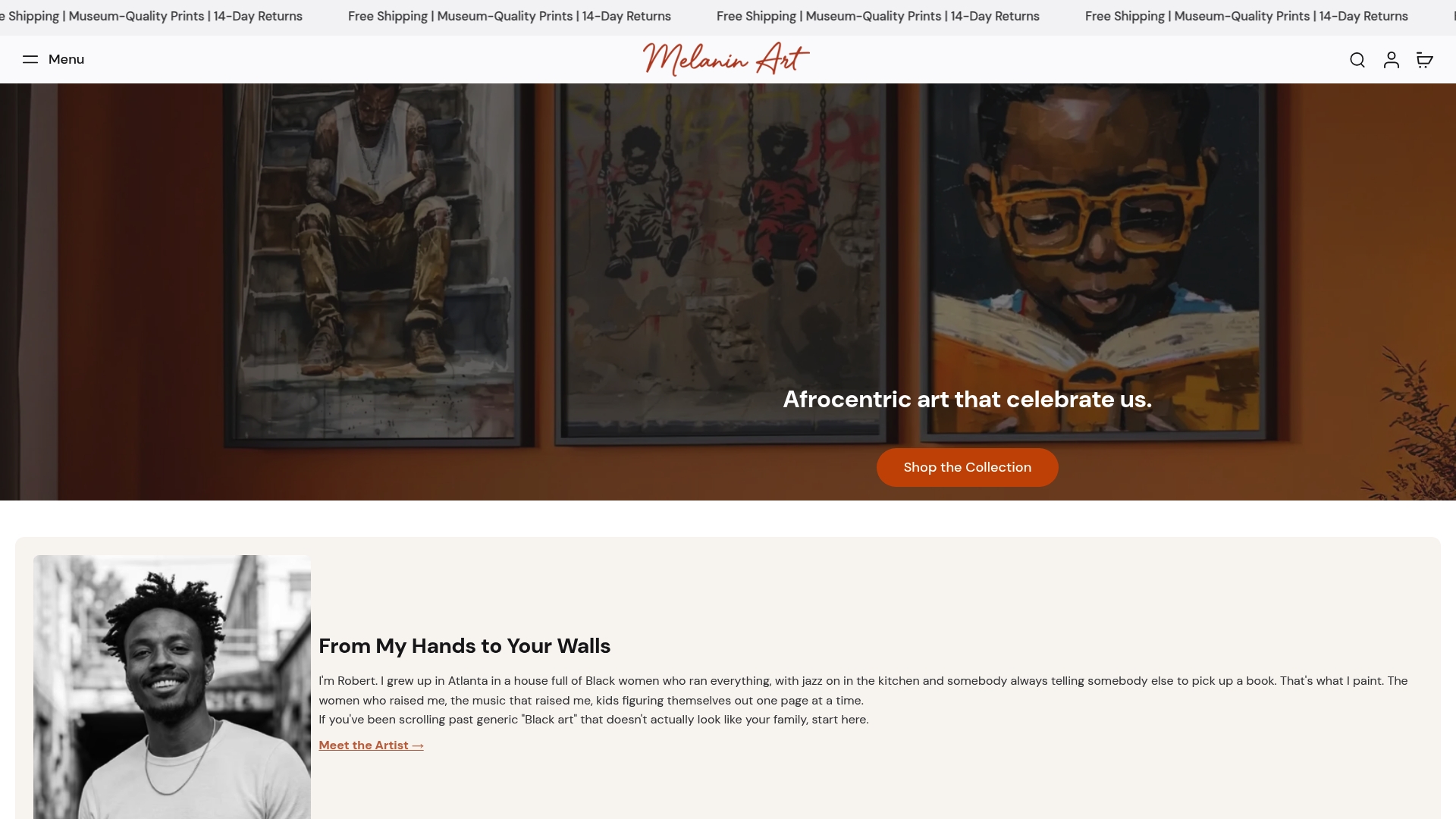
At Melanin Art, every print in our collection begins as an original oil or watercolor painting by artist Robert Lawrence, a creator who brings both technical mastery and deep cultural intentionality to each piece. Whether you are drawn to the celebratory energy of community scenes, the quiet power of individual portraits, or the rich visual language of African heritage, our curated catalog offers museum-grade archival prints that bring these stories into your home. Explore the full collection at melaninart.com and find the work that speaks directly to you.
Frequently asked questions
What is meant by “lived experience” in Black art?
Lived experience refers to the personal, historical, and cultural realities expressed by Black artists through themes, methods, and materials. As the Studio Museum in Harlem documents, lived experience shows up through narrative, abstraction, and material strategies that encode histories such as race, labor, and violence.
How do I identify the meaning behind a Black artist’s work?
Study the themes, structure, and material choices, and research the artist’s background to uncover deeper layers of meaning. Reading meaning across theme, structure, and material is one of the most effective frameworks for appreciating lived experience in Black art.
Are all Black artists focused only on racial themes?
No. While race often informs Black art, many artists emphasize universal, formal, or conceptual aims that go well beyond racial representation. Reducing Black art to only what is racially representative can distort interpretation and ignore an artist’s broader creative intentions.
Which Black art movements best reflect lived experience?
The Black Arts Movement and Harlem Renaissance are two leading examples of movements that institutionalized lived experience through art. Both explicitly linked art to civil rights, Black history, identity, and self-determination in ways that still shape contemporary Black artistry today.
Recommended
- Our People | Black Family Watercolor Wall Art | Afrohemian Art – Melanin Art
- Concrete & Soul | Black Street Art Canvas Prints | Afrohemian Art – Melanin Art
- Free & Rooted | Contemporary Afrocentric Abstract Art | Afrohemian Art – Melanin Art
- Black Man with Beard Art | Deep Study Canvas | Melanin Art