
The Black Arts Movement is defined as a revolutionary cultural and political movement that emerged in the mid-1960s, using poetry, theater, music, and visual arts as tools for Black liberation and racial pride. Formally known as BAM, it stands as the most influential U.S. arts movement in terms of audience engagement and institution building. Figures like Amiri Baraka, Larry Neal, and organizations like Third World Press shaped a cultural force that redefined what art could do. BAM did not ask for a seat at the table. It built its own.
What is the Black Arts Movement and where did it begin?
The Black Arts Movement began in 1965, rooted in the frustration of Black Americans who felt the civil rights movement was moving too slowly and too cautiously. The assassination of Malcolm X that same year acted as a direct catalyst, pushing artists and intellectuals toward a more confrontational, self-determined cultural politics. The movement drew energy from the rising Black Power movement and a collective demand for dignity that went beyond legal reform.
Amiri Baraka founded the Black Arts Repertory Theatre/School in Harlem in 1965, creating the first major institutional hub for politically charged Black artistic development. That single act of institution building set the template for what followed across the country. Community theaters, poetry collectives, and independent presses appeared in cities from Chicago to Detroit to San Francisco.
The history of the Black Arts Movement is inseparable from the Harlem Renaissance that preceded it. BAM artists respected the Renaissance’s achievements but criticized its reliance on white patronage and its failure to produce genuinely radical political art. Where the Harlem Renaissance sought acceptance within existing cultural structures, BAM rejected those structures entirely and built new ones.
Pro Tip: If you want to understand BAM’s origins quickly, read Amiri Baraka’s 1965 essay “The Revolutionary Theatre.” It lays out the movement’s founding logic in under 1,000 words.
Key figures and artistic forms in the movement
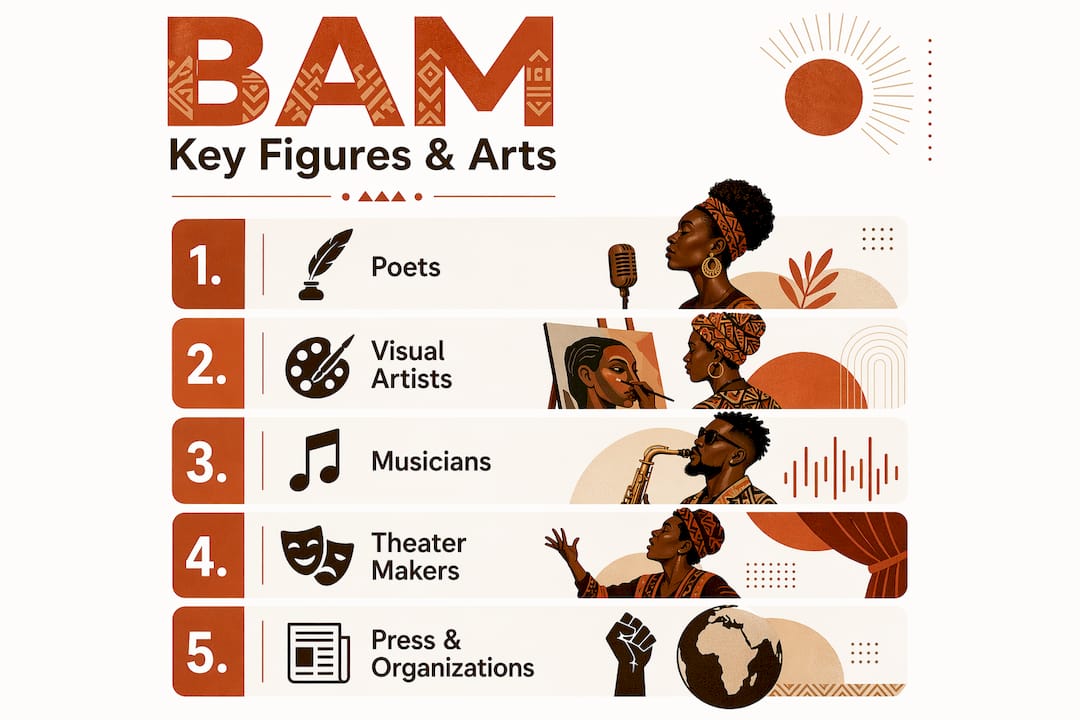
BAM was never a single voice. It was a chorus of writers, visual artists, musicians, and theater makers who shared a political commitment while working across radically different forms.
Poets like Sonia Sanchez, Nikki Giovanni, and Gwendolyn Brooks used verse to reflect the Black experience with raw directness, rejecting the formal conventions of European literary tradition. Their readings were events, not recitals. Audiences in community centers and college campuses heard their own lives spoken back to them with force and beauty.
Visual artist Emory Douglas brought BAM’s politics into graphic form. Douglas created iconic imagery for the Black Panther Party newspaper, using bold illustration to address police brutality, job discrimination, and economic inequality. His work proved that a single image printed on newsprint could carry as much political weight as a manifesto. This connection between BAM and the Black Panther Party shows how tightly art and activism were woven together.
The Organization of Black American Culture (OBAC) in Chicago and Third World Press, the largest Black-owned press in the United States, gave artists the infrastructure to create and distribute work without depending on white-owned institutions. That independence was not a side benefit. It was the point.
| Artist | Medium | Key contribution |
|---|---|---|
| Amiri Baraka | Theater, poetry | Founded Black Arts Repertory Theatre/School; defined BAM’s political framework |
| Nikki Giovanni | Poetry | Brought radical Black consciousness to accessible, widely read verse |
| Sonia Sanchez | Poetry, drama | Merged African oral traditions with Black feminist politics |
| Emory Douglas | Visual art | Created the visual identity of Black Power through the Black Panther newspaper |
| Gwendolyn Brooks | Poetry | Bridged the Harlem Renaissance and BAM; won the Pulitzer Prize in 1950 |
Core philosophies and political goals of BAM
BAM’s central philosophy was simple and radical: art is not decoration. Art is a weapon. BAM artists rejected “art for art’s sake” in favor of cultural production that served Black liberation directly. This was a deliberate break from the idea that aesthetic value and political purpose were separate concerns.
The movement’s core objectives can be understood through three interlocking principles:
- Decolonize the Black mind. BAM argued that centuries of anti-Black racism had distorted how Black Americans saw themselves. Art could undo that damage by presenting Black life, beauty, and history on its own terms.
- Build Black-owned cultural institutions. Controlling the means of cultural production meant that Black artists did not need white publishers, white galleries, or white critics to validate their work.
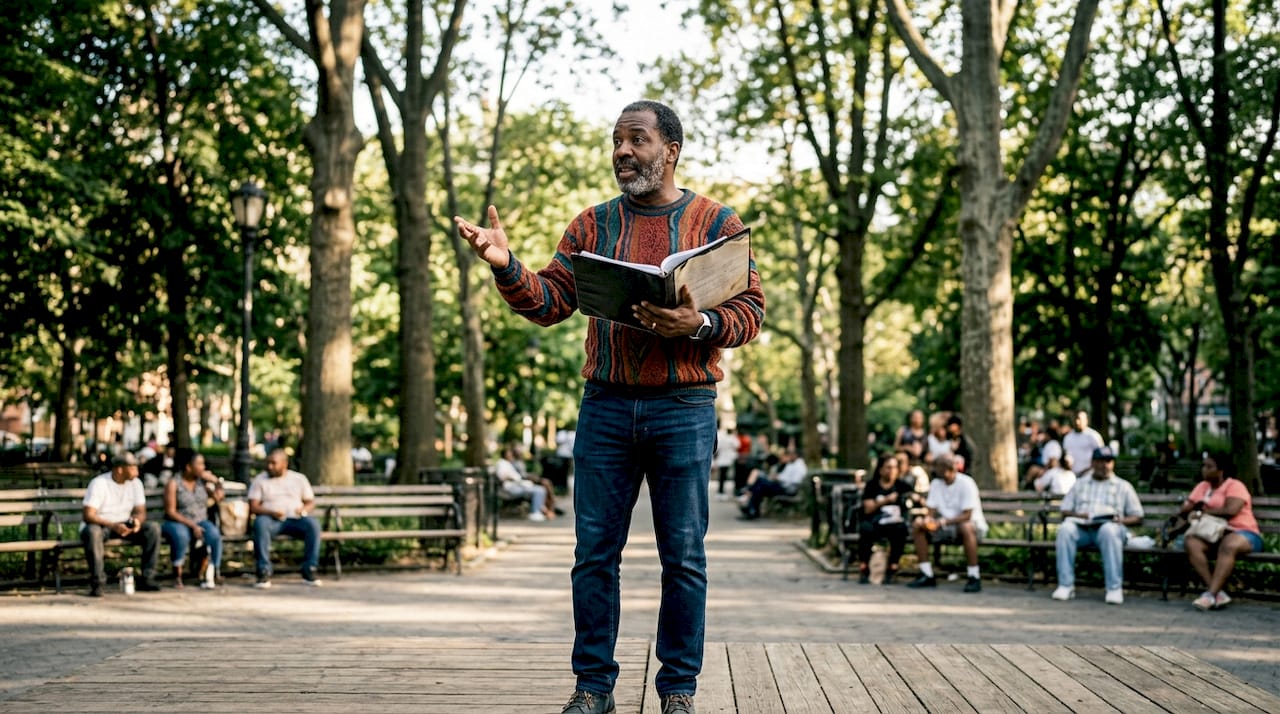
- Connect art to community. BAM performances happened in parks, churches, and community centers, not concert halls. The audience was the neighborhood, not the elite.
“The Black artist must create new forms and new values, sing new songs, and if he must, do this in the lion’s den.” — Larry Neal, The Black Arts Movement, 1968
BAM also drew a sharp contrast with the Harlem Renaissance. BAM sought to produce art by and for Black community venues rather than elite white galleries, treating cultural self-determination as a prerequisite for political freedom. That distinction matters because it explains why BAM built institutions rather than seeking inclusion in existing ones.
Pro Tip: Larry Neal’s 1968 essay “The Black Arts Movement,” published in The Drama Review*, remains the clearest primary source for understanding BAM’s ideology. It is freely available online and worth reading in full.*
The impact and legacy of the Black Arts Movement today
BAM’s legacy is not historical. It is structural. Independent presses like Third World Press and Broadside Press gave generations of Black artists the ability to bypass mainstream gatekeepers and control their own creative distribution. That infrastructure directly enabled the emergence of hip-hop as a self-produced, community-rooted cultural form in the 1970s and 1980s.
The movement’s reach extended well beyond African American communities. BAM was a catalyst for cultural movements in Asian American, Chicano, Puerto Rican, and Native American communities, each of which adapted its model of politically engaged, collectively produced art to their own circumstances. The idea that marginalized communities could use art to define themselves on their own terms traveled across every boundary of race and geography.
Contemporary Black artists working in spoken word, muralism, and Afrofuturism draw directly from BAM’s playbook. You can see its influence in the work of artists like Kehinde Wiley, whose monumental portraits reclaim the visual language of European painting for Black subjects, and in the poetry of Amanda Gorman, whose 2021 inaugural reading carried unmistakable echoes of Nikki Giovanni and Sonia Sanchez.
The impact of the Black Arts Movement also lives in how we talk about representation in art. The demand that Black artists control their own narratives, which BAM made loudly in 1965, is the same demand driving conversations about diversity in publishing, film, and museums today. BAM did not solve that problem. It named it with clarity that still holds.
Key takeaways
The Black Arts Movement established that art created by and for Black communities is both a cultural act and a political one, and that legacy shapes every conversation about representation in art today.
| Point | Details |
|---|---|
| BAM’s founding moment | Amiri Baraka’s 1965 Black Arts Repertory Theatre/School in Harlem launched the movement institutionally. |
| Art as political weapon | BAM rejected aesthetic neutrality and used poetry, theater, and visual art to directly serve Black liberation. |
| Institution building | Third World Press and Broadside Press gave Black artists distribution independence that bypassed white gatekeepers. |
| Global influence | BAM inspired Chicano, Asian American, Puerto Rican, and Native American cultural movements across the U.S. |
| Living legacy | Hip-hop, Afrofuturism, and contemporary debates about representation all trace direct lines back to BAM’s framework. |
What most people miss about BAM
People tend to flatten the Black Arts Movement into a single, unified voice. It was not. BAM contained real ideological disagreements over socialism, Marxism, and the role of African communal traditions, and those debates were often fierce. The movement’s power came partly from that friction, not despite it.
What strikes me most, working with Black art every day, is how BAM’s insistence on community ownership still feels radical. Most cultural institutions today still operate on the Harlem Renaissance model: Black artists producing work that gets validated, purchased, and displayed by predominantly white institutions. BAM called that out sixty years ago. The fact that we are still having the same conversation tells you how deep the problem runs.
The other thing people miss is BAM’s relationship to beauty. The movement is often described purely in political terms, but its artists were also making genuinely gorgeous work. Sonia Sanchez’s poems are not just arguments. They are music. That combination of political clarity and artistic excellence is what made BAM last.
Explore modern African American art that carries this tradition forward, and you will see what I mean.
— Robert
Bring BAM’s spirit into your space
The Black Arts Movement proved that art celebrating Black identity is not a niche interest. It is a cultural necessity. At Melaninart, every piece in our collection continues that tradition. Robert Lawrence’s original oil and watercolor paintings, reproduced as museum-grade archival prints, depict Black life, heritage, and beauty with the same unapologetic pride that BAM demanded. Whether you are drawn to Afrocentric art rooted in African heritage or forward-looking Afrofuturism collections that imagine Black futures, Melaninart offers gallery-quality work that belongs on your walls and in your story.
FAQ
What is the Black Arts Movement in simple terms?
The Black Arts Movement was a 1960s cultural revolution in which Black artists used poetry, theater, music, and visual art as tools for political liberation and racial pride, rejecting white institutional control over Black creative expression.
Who started the Black Arts Movement?
Amiri Baraka is credited with founding the movement when he established the Black Arts Repertory Theatre/School in Harlem in 1965, creating the first major hub for politically engaged Black art.
How did BAM differ from the Harlem Renaissance?
The Harlem Renaissance relied heavily on white patronage and sought cultural acceptance within existing institutions. BAM rejected that model entirely, building Black-owned presses, theaters, and community spaces to control its own cultural production.
What are some examples of Black Arts Movement art forms?
BAM examples include the political poetry of Nikki Giovanni and Sonia Sanchez, the community theater of Amiri Baraka, the graphic activism of Emory Douglas, and the jazz compositions that accompanied spoken word performances at community venues.
Is the Black Arts Movement still relevant today?
Yes. BAM’s institutional legacy, including independent Black-owned presses, directly enabled hip-hop and continues to shape debates about representation, ownership, and the purpose of art in communities fighting for equity.