

Every Harlem Renaissance painting you’ve ever seen of jazz musicians and nightclub crowds carries a meaning most people miss entirely. These weren’t casual scenes of a good time. They were deliberate, political acts. During the Jim Crow era, visual artists transformed Black working-class culture into the subject of serious, gallery-worthy fine art, forcing a society that dismissed Black life as second-class to confront it on its own terms. That tension, between dignity and defiance, is exactly what makes Harlem Renaissance paintings some of the most charged works in American art history.
Table of Contents
- Key takeaways
- What is Harlem Renaissance art and why it matters
- Artistic styles that spoke louder than words
- Jazz, nightlife, and the radical act of painting them
- From underground culture to gallery walls
- My perspective on what these paintings really are
- Bring this legacy into your space
- FAQ
Key takeaways
| Point | Details |
|---|---|
| Art as political defiance | Harlem Renaissance painters deliberately elevated jazz and nightlife into fine art to challenge racist cultural hierarchies. |
| Modernist visual language | Artists used abstraction, silhouette, and geometry to represent collective Black identity rather than individual subjects. |
| The New Negro Movement | Painting was a core tool of the New Negro Movement, asserting Black cultural pride and self-definition during Jim Crow. |
| From underground to institutions | Harlem Renaissance artworks moved from community spaces into galleries and libraries, gaining institutional recognition. |
| Legacy for today | These paintings remain foundational for understanding how Black artists have used visual art to claim cultural authority. |
What is Harlem Renaissance art and why it matters
The Harlem Renaissance spanned the 1920s and 1930s, centered on a cultural and intellectual rebirth rooted in Harlem, New York. It was not simply an art movement. It was the visual arm of a larger campaign for Black dignity, self-determination, and cultural pride known as the New Negro Movement.
The Great Migration brought hundreds of thousands of Black Americans from the rural South to Northern cities, with Harlem becoming the cultural capital of this new urban identity. Artists arriving in this environment didn’t just find inspiration. They found urgency. 1920s black art emerged from a community that needed to see itself reflected with honor in a country that legally and socially denied that honor.
Key conditions that shaped the art of this era:
- The concentration of Black intellectuals, writers, and visual artists in one geographic space created an unusually fertile creative exchange.
- African heritage was not treated as something to leave behind. It was actively woven into modernist visual styles as a source of pride and power.
- Jazz and blues culture gave painters a living, breathing subject that represented both freedom and the complexity of Black urban life.
- Painting collaborations developed most intensely between 1924 and 1929, before the Great Depression disrupted the movement’s momentum.
Understanding this context is what separates a surface reading of these artworks from a genuine one. Harlem art history cannot be understood without understanding the political conditions that made every brushstroke carry weight.
Artistic styles that spoke louder than words
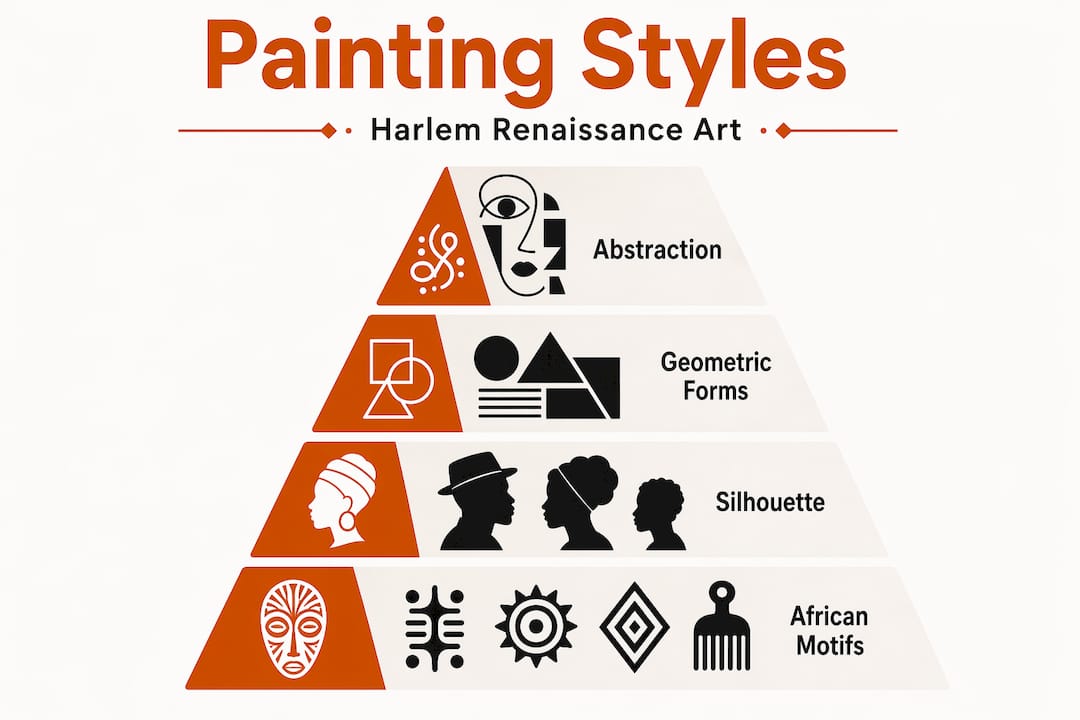
If you expect Harlem Renaissance paintings to look like traditional portraiture or realistic scenes, you’ll be surprised. The artists who defined this period were fluent in modernism. They used it strategically.
Hard-edge abstraction, geometric forms, and Egyptian motifs were not decorative choices. They were a visual language specifically designed to communicate collective Black identity rather than individual realism. This is a critical distinction. When Aaron Douglas painted a crowd as a series of bold silhouettes, he wasn’t being imprecise. He was making a point about community, about “we” rather than “I.”
Here’s how the key artistic strategies worked in practice:
- Silhouette and abstraction. Silhouette style represents communities as collective groups, deliberately shifting the viewer’s focus from the individual to a shared experience. This was a radical move in an era when Black individuals were regularly dehumanized.
- African and ancient Egyptian motifs. Lois Mailou Jones’s “Ascent of Ethiopia” (1932) symbolically connects African heritage to the cultural uplift of the Harlem Renaissance through star and light imagery, tracing a visual journey from Africa toward a new cultural dawn.
- Geometric layering. Overlapping geometric planes created a sense of rhythm and movement that mirrored jazz music itself, making the visual and the sonic inseparable.
- Color as mood and meaning. Deep blues, warm golds, and sharp blacks were used to convey both the vibrancy of nightlife and the gravity of historical struggle happening simultaneously.
Pro Tip: When studying a Harlem Renaissance painting, resist the instinct to read the symbolism literally. A common interpretive error is taking these visual motifs at face value. Consider the commissioning context, the intended audience, and the political moment to unlock the full range of meaning.
Jazz, nightlife, and the radical act of painting them
Here’s what conservative critics, both Black and white, said about jazz in the 1920s: it was rowdy, low-brow, morally suspect street music. Respectable culture wanted nothing to do with it. That shared dismissal makes what Harlem Renaissance painters did all the more audacious.
Artists elevated jazz musicians, flappers, and working-class club-goers to the status of heroic and dignified subjects in large-scale, serious oil paintings. This was not nostalgia or entertainment. It was a sociopolitical campaign to force fine art institutions to recognize Black popular culture as worthy of the same space and attention given to European subjects.
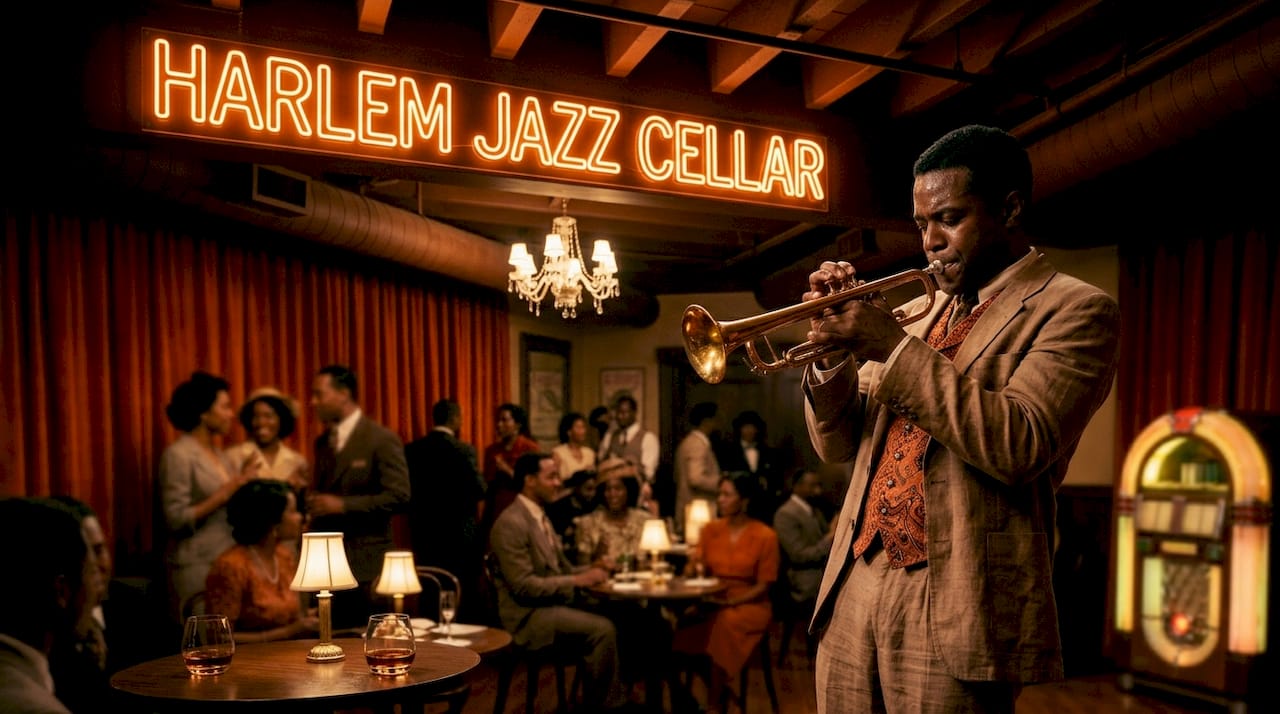
Aaron Douglas’s “Song of the Towers” (1934) makes this argument in visual form. A jazz musician silhouette stands against a stylized New York skyline, saxophone raised, surrounded by modernist geometric light. The figure isn’t just playing music. He represents freedom, tension, and the complex reality of Black life in an industrialized, racially hostile America.
Key elements that made jazz-themed paintings politically defiant:
- Placing club-goers and musicians in the compositional position traditionally reserved for saints, heroes, and noblemen in Western painting.
- Using scale and formal complexity to signal seriousness, insisting these subjects deserved the same visual treatment as any European masterwork.
- Embedding symbols of societal tension, like gears, chains, and reaching hands, alongside the music to acknowledge struggle without surrendering to it.
“Interpreting Harlem Renaissance paintings involves connecting iconic visual motifs, jazz instruments, city skylines, and silhouettes, with the social and historical contexts that gave them meaning.” Ms. Miller’s Explanatory Blog
From underground culture to gallery walls
The journey of Harlem Renaissance artworks from community spaces to institutional galleries is one of the most significant chapters in American art history. It did not happen by accident. It was the result of deliberate effort by artists, patrons, and cultural organizations who understood that physical location determines cultural legitimacy.
| Community Space | Institutional Space |
|---|---|
| Church halls and social clubs | Public libraries and municipal galleries |
| Underground jazz venues | Museum exhibitions in major cities |
| Community newspapers and magazines | Academic art publications and catalogs |
| Informal networks of Black patrons | White-run foundations and art commissions |
Through commissions and exhibitions, Harlem Renaissance art gained recognition well beyond the underground communities that first nurtured it. This transition was itself a political statement. Every time a painting of a jazz musician or a community elder was hung in a white-run institution, it forced a confrontation with the humanity and cultural sophistication that racist ideology denied.
Artists like Aaron Douglas, Jacob Lawrence, and others became central to academic study precisely because their work operated on multiple levels at once, as aesthetically sophisticated art and as cultural argument. The fusion of modernist visual strategies with themes of race pride, migration, and affirmation made these paintings impossible to dismiss on purely formal grounds.
Pro Tip: When exploring Harlem Renaissance artworks as a student or collector, look at Aaron Douglas’s “Aspects of Negro Life” series as a sequential historical narrative rather than individual paintings. Each panel builds on the last, like chapters in a book about collective Black identity.
My perspective on what these paintings really are
I’ve spent years painting Black culture, and the longer I work with these themes, the more I’m convinced that most people dramatically underestimate how radical Harlem Renaissance painting was. We have a tendency to categorize art from the past as “of its time,” which is another way of making it feel safe and distant. These paintings were not safe. They were arguments.
What strikes me most is the discipline required to paint defiance beautifully. It would have been easy to make angry, explicitly political work. What Douglas and Jones and their peers did was far harder. They made work that was formally extraordinary so that no one could dismiss it on aesthetic grounds, and then they filled it with meaning that any honest viewer had to reckon with.
The lesson I take from that for my own work is that beauty and politics aren’t opposites. In the right hands, beauty is the weapon. These artists understood that getting their work into galleries and libraries meant winning not just a cultural argument but a permanent one. The work outlasted the critics who dismissed it, and that’s the point.
If you want to understand Black identity in America, you don’t start with the obvious. You start with these paintings, with what they chose to elevate, and why.
— Robert
Bring this legacy into your space
The tradition of Harlem Renaissance painting lives on, and you don’t need a gallery membership to engage with it. Melaninart’s Harlem Renaissance collection brings this era’s visual power into your home through museum-grade archival prints. Each piece is reproduced from original oil and watercolor paintings by artist Robert Lawrence, capturing the richness and depth that makes this art worth living with. From jazz-inspired quartet prints to full session music artwork, these prints connect you directly to one of America’s most defiant artistic legacies. Explore the collection and find the piece that speaks to you.
FAQ
What is Harlem Renaissance art?
Harlem Renaissance art refers to the visual artworks produced by Black American artists during the 1920s and 1930s in and around Harlem, New York. These works used modernist styles to assert Black cultural identity, dignity, and political defiance during the Jim Crow era.
Who were the most important Harlem Renaissance painters?
Aaron Douglas and Lois Mailou Jones are among the most studied Harlem Renaissance painters, alongside Jacob Lawrence. Their work used abstraction, silhouette, and African motifs to communicate collective Black identity and cultural pride.
Why did Harlem Renaissance artists paint jazz musicians?
Painting jazz musicians was a deliberate political act. Conservative critics dismissed jazz as low-brow, so artists responded by placing musicians and club-goers in compositionally heroic roles within serious fine art, forcing cultural institutions to recognize Black popular culture as worthy of the gallery wall.
What artistic styles defined Harlem Renaissance painting?
Harlem Renaissance painters used hard-edge abstraction, geometric forms, silhouette composition, and Egyptian and African motifs. These modernist strategies communicated collective Black identity and social themes rather than individual realism.
How did Harlem Renaissance paintings influence later Black art?
Harlem Renaissance artworks established the foundation for using visual art as cultural and political argument. Their transition from community spaces to institutional galleries created a legacy that continues to shape how Black artists approach identity, heritage, and representation in contemporary art.