

A contemporary Black artist is defined as an artist of African descent whose work engages with current cultural, political, and personal experiences through modern artistic expression. This definition covers a wide spectrum, from Amy Sherald’s monumental portraiture to Sonia Boyce’s immersive sound installations. These artists are not a monologue. They are a chorus of distinct voices, mediums, and philosophies reshaping what art means globally. For collectors and enthusiasts, understanding who these artists are and what drives their practice is the first step toward building a collection that genuinely matters.
What mediums do contemporary black artists use?
Black contemporary art draws from an unusually broad toolkit. Painting, photography, sculpture, digital portraiture, performance, and large-scale installation all appear within the same generation of artists. That range is not accidental. It reflects a deliberate refusal to be confined to any single tradition.
Fausat Ladokun represents one of the most compelling examples of this approach. Her digital portraiture practice directly challenges colonial visual narratives by reconstructing African identity through technology. Artists emerging in the late 1980s and 1990s increasingly use platforms like Domestika for skill development, which means the barrier to mastering new digital tools has dropped significantly. That accessibility is producing a generation of technically versatile artists faster than any previous era.
Here is how the medium diversity breaks down across common practice areas:
- Painting and drawing: Oil, watercolor, and acrylic remain foundational, especially for artists focused on portraiture and cultural storytelling.
- Photography and film: Used to document community, identity, and diaspora experience with documentary precision.
- Digital and mixed media: Artists like Fausat Ladokun blend traditional composition with digital tools to reach global audiences and challenge archival erasure.
- Installation and performance: Immersive works that transform physical space into cultural argument, as seen in Sonia Boyce’s Golden Lion prize winning work at the Venice Biennale.
Pro Tip: When evaluating a modern Black artist’s work, look beyond the final object. Ask what medium choices say about the artist’s relationship to technology, tradition, and audience.
Which themes and narratives shape contemporary black art?
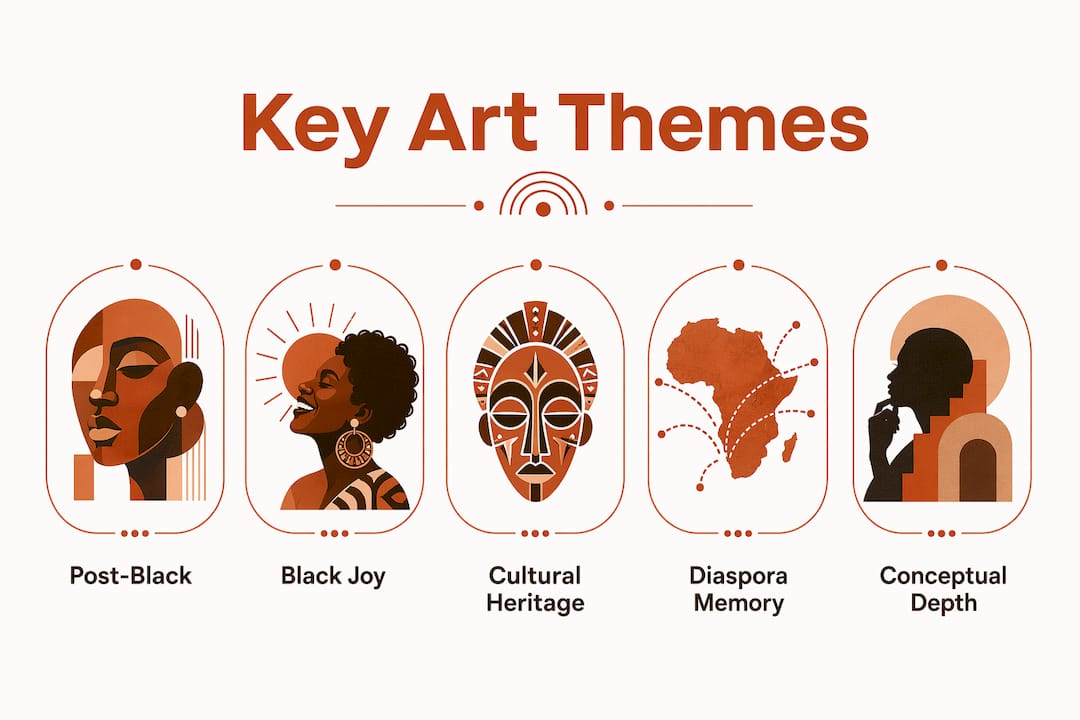
The thematic range in black contemporary art is wider than most collectors initially expect. Identity and history anchor many practices, but they are not the whole story. Three major thematic currents define the field right now.
1. Post-black conceptualism
Curator Thelma Golden’s “post-black” framework is the most important critical lens for understanding artists like Rashid Johnson. Johnson integrates conceptualism, Afrofuturism, and mental health into work that refuses simple racial categorization while remaining deeply rooted in Black cultural experience. The post-black position is not a rejection of identity. It is a demand for complexity.
2. Black joy as intellectual discipline
Derrick Adams and Shae Anthony have built entire practices around leisure, beauty, and self-representation in Black life. This is a direct counter to the historical tendency of Western art institutions to frame Black subjects primarily through trauma and servitude. Black joy is a rigorous intellectual pursuit, not a soft alternative to social critique. Pieces like Melaninart’s Black Boy Joy reading art reflect exactly this tradition.
3. Cultural heritage and diaspora memory
Many artists work explicitly with African history, ancestral knowledge, and diasporic experience. Shani Crowe’s community adornment rituals function as both art and cultural preservation. These works ask viewers to reckon with what has been lost, carried, and transformed across generations.
The three currents often overlap within a single artist’s body of work. That overlap is what makes collecting in this space so intellectually rewarding.
How are emerging black artists reshaping the art world?
Emerging Black artists are redefining where art happens and who it serves. The gallery is no longer the only legitimate venue. Community spaces, digital platforms, and after-school programs are now active sites of artistic production and cultural transmission.
The Private Art Development Programme is a direct example. It develops creative intelligence in young Black artists aged 4–15 through 60–90 minute sessions designed to track emerging talent beyond the gallery system. That kind of structured early development produces artists with both technical skill and cultural grounding before they ever enter a formal art institution.
Artists like JUSTKIN and Shani Crowe extend their practices into community education and social processes, treating art as something that happens between people, not just on a wall. This shift has real implications for collectors.
| Approach | What It Means for Collectors |
|---|---|
| Gallery-based practice | Established market pricing, provenance documentation, institutional validation |
| Community-rooted practice | Emerging valuation, deeper cultural context, direct artist relationships |
| Digital-first practice | Global reach, accessible price points, growing institutional interest |
| Diaspora-focused practice | Local market strength, independence from Western gallery systems |
Naila Opiangah makes the market argument plainly. She stresses decentralizing the art market so that African and diasporic community recognition drives long-term artistic independence. That shift is already underway, and collectors who recognize it early will have access to significant work before Western institutions catch up.
Pro Tip: Follow emerging Black artists on platforms like Instagram and Domestika before their work enters gallery representation. That is where you see the practice develop in real time.
How do collectors value works by top contemporary black artists?
Valuing work by top contemporary Black artists requires more than price comparison. It requires understanding the conceptual position each artist occupies and how that position relates to market dynamics.
The most useful framework for collectors is the distinction between post-black abstraction and culturally celebratory work. Collectors who conflate the two risk building collections that look diverse on the surface but lack genuine thematic coherence. That is the definition of theme-based tokenism, and it weakens both the collection and the collector’s credibility.
Here is what to examine before acquiring a work:
- Conceptual position: Does the artist operate within the post-black framework, the Black joy tradition, or a diaspora memory practice? Each carries different critical histories and collector communities.
- Market validation source: Is the artist recognized primarily by Western institutions, local African or diasporic markets, or both? Artists with strong local market roots often carry more long-term independence and cultural authority.
- Social practice dimension: Does the artist’s work extend into community education, performance, or social engagement? Collectors who value social processes alongside physical artworks build collections with deeper cultural resonance.
- Institutional trajectory: Amy Sherald’s Smithsonian solo exhibition and Sonia Boyce’s Venice Biennale recognition set a new career baseline. Track where emerging artists are showing and who is writing about them.
The collectors who do this work build collections that hold meaning across decades, not just market cycles.
Key takeaways
The most effective way to engage with contemporary Black art is to understand each artist’s conceptual position, medium choices, and community relationships before making any collecting decision.
| Point | Details |
|---|---|
| Definition matters | A contemporary Black artist engages current cultural and personal experience through modern artistic expression. |
| Medium diversity signals intent | From digital portraiture to community performance, medium choices reveal an artist’s relationship to tradition and audience. |
| Themes go beyond trauma | Post-black conceptualism, Black joy, and diaspora memory are three distinct currents that require separate critical frameworks. |
| Community roots add value | Artists with strong local and diasporic market recognition carry long-term independence from Western gallery systems. |
| Collector framework is critical | Distinguishing post-black abstraction from cultural celebration prevents tokenism and builds coherent, meaningful collections. |
What i’ve learned watching this field evolve
I have spent years working with Afrocentric art, and the single biggest mistake I see collectors make is treating Black contemporary art as a monolithic category. They buy a Derrick Adams print and a Rashid Johnson concept piece and assume they are building a coherent collection. They are not. Those two artists are operating from fundamentally different philosophical positions, and a collection that ignores that difference ends up saying nothing.
The shift I find most exciting right now is the move toward local market sustainability. Western institutional validation used to be the only path to serious recognition. That is no longer true. Artists like Naila Opiangah are building careers rooted in African and diasporic community recognition, and that independence produces bolder, more culturally honest work. The art does not have to perform for a Western gaze. It can simply be what it is.
The challenge for collectors is keeping up. The most significant emerging Black artists are often not in major galleries yet. They are in community spaces, on digital platforms, and in programs like the Private Art Development Programme. If you wait for institutional validation, you will always be late.
— Robert
Bring contemporary black art into your space
Melaninart curates museum-grade prints that reflect the full range of modern Black artistic expression, from ancestral heritage to contemporary joy. The Afrocentric art collection features original oil and watercolor paintings by Robert Lawrence, reproduced as archival prints with the color depth and durability that serious collectors expect. For something that speaks directly to cultural identity and pride, Unbothered and Rooted are two standout pieces that carry real weight on any wall. Explore the full Afrofuturism collection for work that pushes the conversation forward.
FAQ
Who are the most recognized contemporary black artists today?
Amy Sherald, Sonia Boyce, Rashid Johnson, and Derrick Adams are among the most recognized. Sherald holds a Smithsonian solo exhibition and Boyce won the Golden Lion at the Venice Biennale, setting a new standard for institutional recognition.
What is “post-black” art?
Post-black art is a framework developed by curator Thelma Golden that describes work by Black artists who engage deeply with their cultural background while rejecting reductive racial categorization. Rashid Johnson is the most cited example of this approach.
How do i start collecting works by emerging black artists?
Follow artists on digital platforms before they enter gallery representation, attend community-based exhibitions, and research whether an artist’s recognition comes from local diasporic markets or Western institutions. Both paths produce significant work, but they carry different valuation dynamics.
What is black joy in contemporary art?
Black joy is an intellectual framework that centers leisure, beauty, and self-representation in Black life as serious artistic subjects. Derrick Adams and Shae Anthony are its most prominent advocates, directly challenging the historical confinement of Black subjects to trauma narratives in Western art.
Why does medium choice matter when evaluating black contemporary art?
Medium choice reveals an artist’s relationship to tradition, technology, and audience. Digital portraiture artists like Fausat Ladokun use technology to challenge colonial visual narratives, while installation artists use physical space as cultural argument. Understanding that choice deepens both appreciation and collecting decisions.