

Most people encounter tribal African art inside a glass case. A carved mask, a polished wood figure, a woven object set on a white pedestal with a label telling you what century it came from. And that experience, while better than nothing, misses almost everything that matters. Tribal African art — or more precisely, African traditional art — is not a static category of objects. It is a living, breathing system of meaning where form, performance, and community are inseparable. From the Yoruba Géleédé ceremonies of West Africa to the Mende Sande dances of Sierra Leone, these objects speak loudest when they move.
Table of Contents
- Key takeaways
- What tribal African art really means culturally
- The Yoruba Géleédé mask and performance
- Mende Sande society paintings and female power
- My perspective on art that performs
- Explore African heritage art at Melaninart
- FAQ
Key takeaways
| Point | Details |
|---|---|
| Art lives in performance | African traditional objects gain full meaning through movement, music, and community participation, not display alone. |
| Symbolism is layered | Animal motifs, geometric forms, and materials each carry specific social and spiritual messages. |
| Female power is central | Traditions like Yoruba Géleédé and Mende Sande place women’s spiritual authority at the heart of the art. |
| Context determines value | Identifying genuine tribal art requires understanding provenance, ritual function, and cultural origin. |
| Modern art owes a debt | African traditional art shaped the abstraction and bold geometry of 20th-century Western art movements. |
What tribal African art really means culturally
The phrase “tribal African art” is widely used, but the more precise term scholars and curators use is African traditional art. That distinction matters because “tribal” can flatten the enormous diversity of hundreds of distinct cultures, each with its own visual language. Whether you use the popular phrase or the academic term, the core principle holds. These objects were created with specific social, spiritual, and political purposes in mind.
African tribal masks and traditional African sculptures were not decorative objects in their original contexts. Ritual objects embodied ancestral spirits, fertility forces, and protective powers. A helmet mask used in funerary rites, a carved figure kept in a shrine, a bronze prestige item held by a chief: each of these served a function as specific as a tool.
Here is what that cultural function looked like across three distinct traditions:
- Yoruba (West Africa): Masks and carvings mediated relationships between the living and ancestral forces, with performances serving as social governance and moral instruction.
- Fang (Central Africa): The Janus Fang mask, characterized by minimal decoration and visible tool marks, was designed for ceremonial use as a protective ritual entity.
- Mende (Sierra Leone): Masquerades and carved objects were integrated into the all-female Sande society’s initiation rites, making them among the rare examples of women as the primary custodians and performers of masquerade traditions.
The critical problem with how museums often present these objects is that objects lose meaning when stripped from their performance, audience, and ritual context. A Géleédé carving in a case is like reading the lyrics to a song without the melody.
Pro Tip: When you visit a museum or gallery featuring African art, look for any contextual materials that describe how the object was used, not just when it was made. That single question changes what you see entirely.
The Yoruba Géleédé mask and performance
Few examples in African heritage art are as well documented and as richly performative as the Yoruba Géleédé ceremony. And understanding it completely reshapes how you think about every African mask you will ever see.
Géleédé is a public performance tradition honoring what Yoruba culture calls “our mothers,” the powerful women and female spiritual forces whose goodwill is considered necessary for community well-being. Géleédé honors powerful women through elaborate public performances where male dancers wear the headdresses, moving through marketplaces and open community spaces to praise and appease female spiritual authority. The mask itself is only one ingredient.
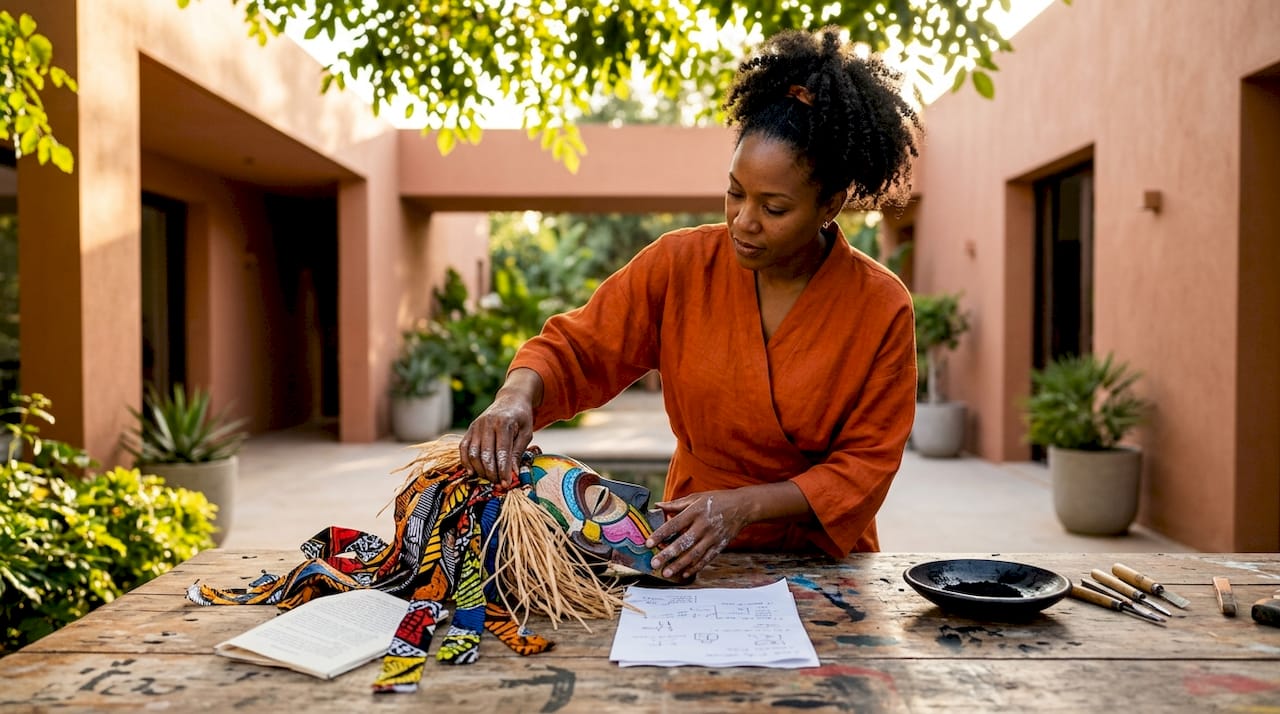
Here is how the layers of meaning build in a Géleédé performance:
| Element | What it contributes |
|---|---|
| The carved headdress | Depicts animal motifs and compressed imagery encoding social lessons |
| Costume and fabric | Transforms the performer’s body into a spiritual presence |
| Music and drum rhythm | Controls the timing and meaning of movement sequences |
| Audience participation | Completes the performance; their response activates the social critique |
| The marketplace setting | Amplifies visibility and connects the ceremony to everyday community life |
“Géleédé carvings gain their meanings fully only when moving through space, accompanied by music and community participation.” — Historical Nigeria
Headdresses communicate social lessons through compressed imagery and animal metaphors that are easy to recognize. A serpent motif might reference wisdom or danger. A bird could evoke the mysterious power of elder women. These were not abstract art choices. They were public messaging systems, legible to every community member who watched.
Mende Sande society paintings and female power
While many masquerade traditions in Africa are male-dominated, the Mende people of Sierra Leone built something extraordinary: a powerful, all-female spirit and educational society called the Sande. Paintings depicting Sande women dancing together in ritual garments are among the most striking and mystically charged works in the broader category of African cultural art. They deserve careful reading.
When you look at these ceremonial paintings, every visual element carries meaning:
- Synchronized movement is not just a compositional choice. It represents sisterhood, shared knowledge, and the secrets that bind initiates together across generations.
- Fluid, flowing brushstrokes mimic the rhythm of the dance itself. A skilled painter translates sacred energy into movement on canvas, so the wall where the work hangs becomes an active space rather than a passive one.
- Ritual garments depicted in white or deep indigo signal spiritual transformation and the boundary between the everyday world and the sacred.
- Posture and grouping communicate the collective identity of the society. No single figure dominates. The power belongs to all of them together.
- Facial expressions in Sande-inspired works often carry a quality of inward calm, reflecting the deep knowledge and spiritual authority the society holds.
These works connect directly to the Sande’s educational role. The society governed the transition of young women into adulthood, transmitting cultural knowledge, medicinal practice, and communal values. A painting of the Sande dance is therefore not decorative. It is a living record of a system that sustained communities across centuries.
Materials, motifs, and their symbolic meanings
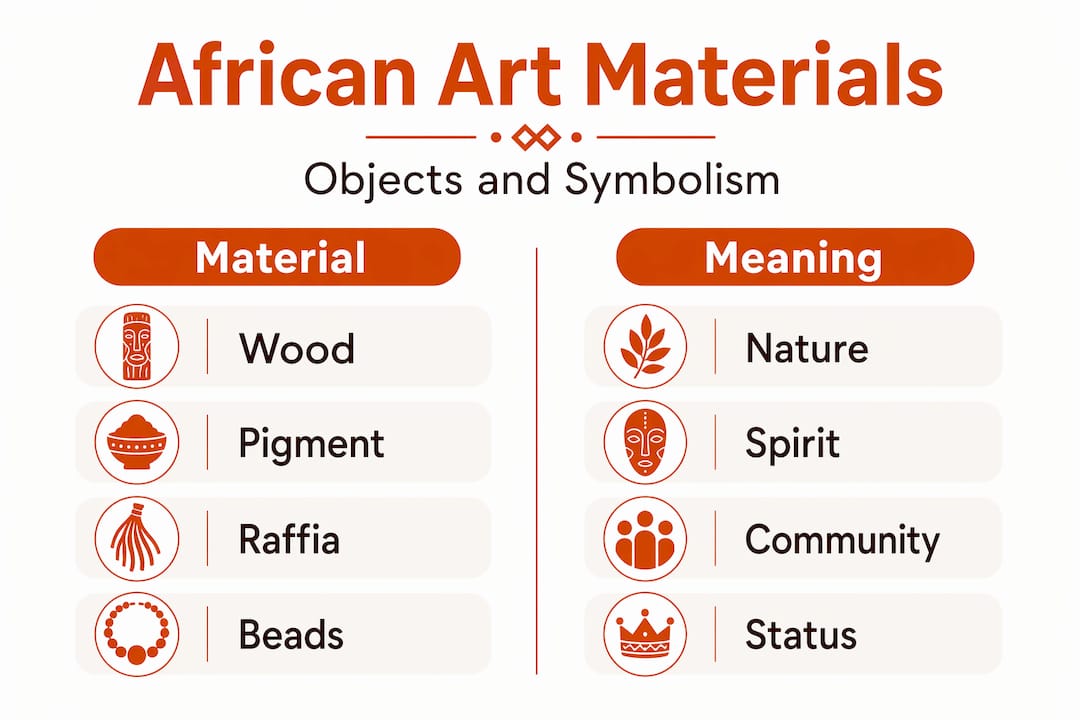
The materials used in indigenous African crafts are never neutral. Wood, pigments, and raffia typically appear in masks made for dance and ceremony. Iron and bronze signal prestige and ritual power. Beads mark fertility and social rank. Each material choice is a deliberate communication.
| Material | Typical use | Symbolic meaning |
|---|---|---|
| Wood | Masks, figures | Connection to living nature and ancestral forces |
| Iron/bronze | Implements, prestige items | Authority, permanence, spiritual power |
| Raffia | Costume elements | Transformation, concealment of human identity |
| Beads | Jewelry, fertility objects | Status, protection, life energy |
The stylistic features that define African traditional art, including abstraction, stylized human proportions, and geometric patterning, are not simplifications. African art influenced Picasso and other European modernists precisely because this visual language was so sophisticated in its symbolic expressiveness. These artists recognized what they could not fully understand: that every formal choice carried meaning far beyond decoration.
Pro Tip: When studying African art styles, pay attention to exaggerated features. Oversized eyes often signal heightened spiritual perception. Extended necks in Mende carvings reference beauty and social refinement as defined by that specific culture.
How to identify, appreciate, and collect responsibly
Learning how to identify tribal art is as much about asking the right questions as reading visual details. Here is a practical framework:
- Ask about provenance. Where did the object come from? Who made it, and under what circumstances? An object without provenance history is an object without a story, and stories are the point.
- Distinguish ritual from tourist production. Ritual objects show signs of actual use: wear patterns, residue from offerings, repairs made in the field. Tourist reproductions are clean, uniform, and made for sale.
- Learn the cultural narrative. A Fang mask means something completely different from a Yoruba headdress. Tribal artwork collections built without that knowledge are just aesthetic accumulations.
- Support indigenous artists directly. Contemporary African artists working in traditional forms and contemporary interpretations deserve recognition and revenue.
- Prioritize cultural institutions and verified sellers. When purchasing, seek out platforms and dealers who can speak to artist identity, cultural origin, and ethical sourcing.
My perspective on art that performs
I have spent years looking at African art, both as an artist and as someone who believes that what goes on your walls shapes how you see yourself and your heritage. What I keep returning to is this: the biggest mistake collectors and admirers make is treating these works as endpoints. A mask hanging on a wall. A sculpture on a shelf. That framing is a Western museum habit, and it is not where the power of this art lives.
What moved me most when I deepened my research into Yoruba and Mende traditions was how central women are to the spiritual logic of these art systems. The Géleédé exists to honor female power. The Sande is governed entirely by women. These are not footnotes. They are the foundation. When you view African tribal women art, you are encountering centuries of that understanding translated into visual form.
My hope is that you stop seeing African traditional art as something from the past. It is an ongoing conversation. The women of the Sande danced last year. The Yoruba are performing Géleédé right now. That living pulse is what I try to honor in the work I create and share.
— Robert
Explore African heritage art at Melaninart
If this article has opened up how you think about African cultural art, the next step is living with it. Melaninart’s Afrocentric art collection brings together works that honor African identity, tradition, and storytelling with the depth these subjects deserve. Every piece in the catalog is drawn from original oil or watercolor paintings by artist Robert Lawrence, reproduced as museum-grade archival prints built to last. For those drawn to visions of African futures shaped by African pasts, the Afrofuturism collection extends those themes into contemporary expression. You can also explore pieces honoring ancestral village themes that connect directly to the traditions covered here.
FAQ
What is the difference between tribal art and traditional African art?
“Tribal African art” is the popular and widely searched term, while “African traditional art” is the more precise academic phrase. Both refer to art created within specific African cultural communities for social, spiritual, or ceremonial purposes.
Why do African tribal masks gain meaning through performance?
Masks gain meaning through the combination of costume, music, movement, and audience interaction. Without that performative context, a mask is only a carved object rather than a living cultural expression.
What is the Mende Sande society?
The Sande society is a powerful, all-female spirit and educational organization among the Mende people of Sierra Leone. It governs female initiation, transmits cultural knowledge, and is one of the few African traditions where women are the primary masquerade performers.
How can I tell if a piece of African art is authentic?
Look for signs of actual use such as wear, repairs, and patina, and ask about provenance and cultural origin. Authentic African objects typically show evidence of ritual function rather than the uniform finish of decorative reproductions.
How did African traditional art influence Western art?
African art introduced bold geometry, stylized abstraction, and symbolic expressiveness to European artists in the early 20th century. Artists like Picasso drew directly from African visual language, reshaping modern art in ways that are still visible today.