

Most people think of Harlem Renaissance art as dignified portraits and cultural celebration. That reading is accurate but incomplete. The artists who defined this movement were doing something far more radical. They were doing exactly what Louis Armstrong did to a melody: taking familiar forms and breaking them apart, rebuilding them into something the world had never seen before. Harlem Renaissance art was not traditional representation. It was the birth of Black graphic modernism, and understanding that changes how you see every painting from the era.
Table of Contents
- Key Takeaways
- Harlem Renaissance art and its jazz-era roots
- How painters translated jazz improvisation onto canvas
- Profiles of the movement’s key voices
- The impact of Harlem Renaissance art on Black expression today
- My take on the jazz-canvas connection
- Own a piece of this cultural legacy
- FAQ
Key Takeaways
| Point | Details |
|---|---|
| Jazz as visual blueprint | Harlem Renaissance painters used the same improvisational logic as jazz musicians to reinterpret African motifs and historical narratives. |
| First international Black art movement | The Harlem Renaissance spanned 1918 to the late 1930s and was the first African American-led modern art movement with global reach. |
| Abstraction as resistance | Breaking from European classical composition was a deliberate political act, not just an aesthetic choice. |
| Artists built institutions | Augusta Savage trained over 1,500 people, proving the movement was as much about access as it was about art. |
| Legacy lives in modern Black art | The movement’s philosophy of cultural reclamation continues to shape Afrocentric and Afrofuturist artistic expression today. |
Harlem Renaissance art and its jazz-era roots
The Harlem Renaissance was the first African American-led international modern art movement, running from roughly 1918 through the late 1930s. It did not emerge from nowhere. The Great Migration brought hundreds of thousands of Black Americans from the rural South to Northern cities, with Harlem becoming the cultural epicenter of that shift. When you concentrate that much talent, pain, ambition, and creativity into one neighborhood, something new has to come out of it.
Jazz was the sound of that transformation. Musicians like Duke Ellington and Louis Armstrong took the structured forms of European classical music and bent them past recognition. They kept the melody as a reference point and then improvised wildly over it, creating something simultaneously familiar and completely new. This was not chaos. It was a sophisticated, deliberate departure from rigid rules.
The visual artists of the Harlem Renaissance were doing the same thing on canvas. Consider what they were working against:
- Centuries of European classical composition that defined what “serious” art looked like
- A mainstream art world that either ignored Black artists or expected them to produce work that confirmed white audiences’ expectations
- The pressure to represent an entire community while also pushing artistic boundaries
The Great Migration’s concentration of African American urban culture created the conditions for a new modern identity to emerge through art. These painters, sculptors, and photographers were not working in isolation. They were feeding off each other the same way jazz musicians fed off each other in a live session.
How painters translated jazz improvisation onto canvas
Here is the core comparison that most 1920s art history courses miss. Jazz improvisation works by taking a known structure, a chord progression or a melody, and departing from it in real time. The departure is the art. The original structure is just the launching pad.
Harlem Renaissance painters did this with African motifs, Egyptian iconography, and historical Black narratives. They did not simply reproduce those references. They abstracted them, distorted them, and rebuilt them into a new visual language that spoke to the modern urban Black experience. This is what makes the movement genuinely modernist, not just culturally significant.
Aaron Douglas’s signature style demonstrates this perfectly. His silhouettes, geometric abstraction, and layered African motifs collapse centuries of time into a single image. He was not painting Africa as it was. He was improvising on Africa as a theme, the same way a jazz musician improvises on a standard. The result was a proud visual language that directly challenged racist stereotypes while creating something aesthetically new.
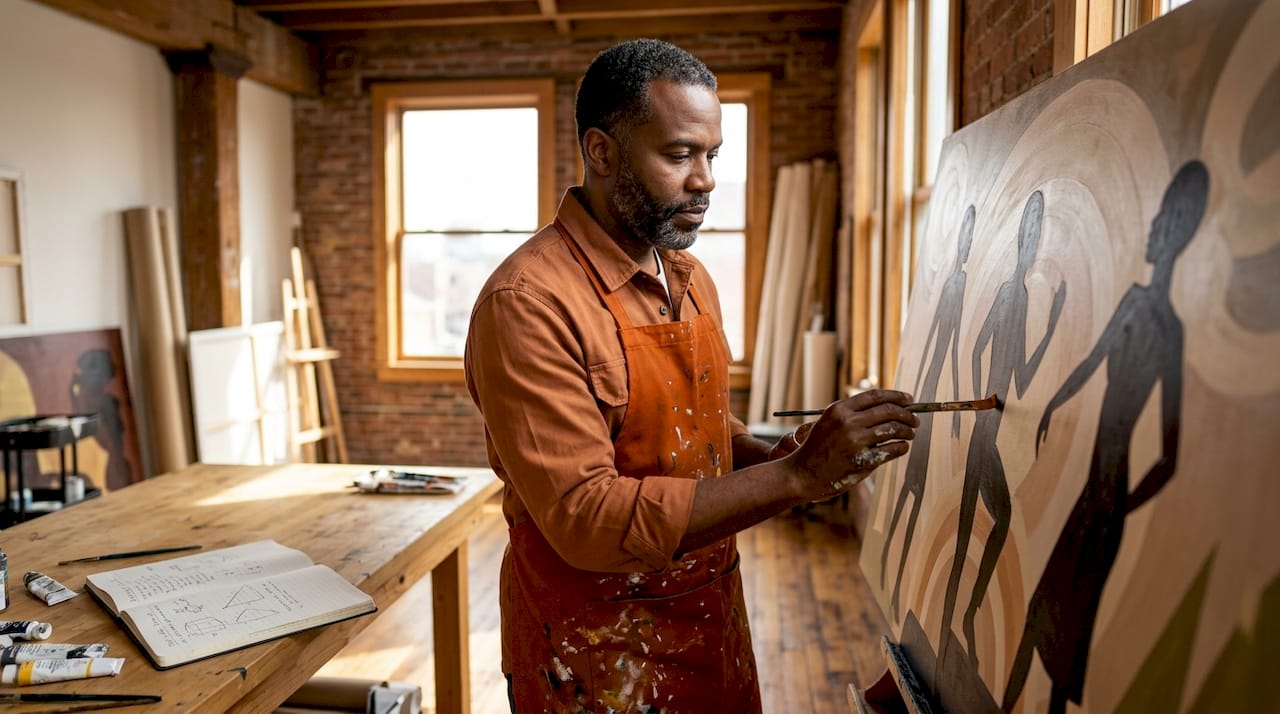
The parallel holds when you look at how these artists engaged with European modernism. Many New Negro artists spent extended time in Europe and engaged with the avant-garde movements there. They absorbed cubism, expressionism, and African-influenced European abstraction, then brought those tools back and used them to tell Black stories. That is the jazz move: learn the form, then break it on your own terms.
Here is a useful way to think about the progression:
- Learn the structure. Harlem Renaissance artists studied European classical composition and academic painting traditions.
- Identify the reference point. African heritage, historical Black narratives, and community life became the “melody” they would improvise over.
- Depart deliberately. Geometric abstraction, silhouette, flat color planes, and layered symbolism replaced realistic representation.
- Create something new. The result was Black graphic modernism: a visual language with no direct European precedent.
Pro Tip: When studying Harlem Renaissance paintings, look for the tension between the recognizable reference and the abstraction. That tension is the improvisation. It is where the real artistic statement lives.
Profiles of the movement’s key voices
Understanding the movement means understanding the specific artists who shaped it. Three figures stand out not just for their talent but for how differently they each interpreted the jazz ethos.
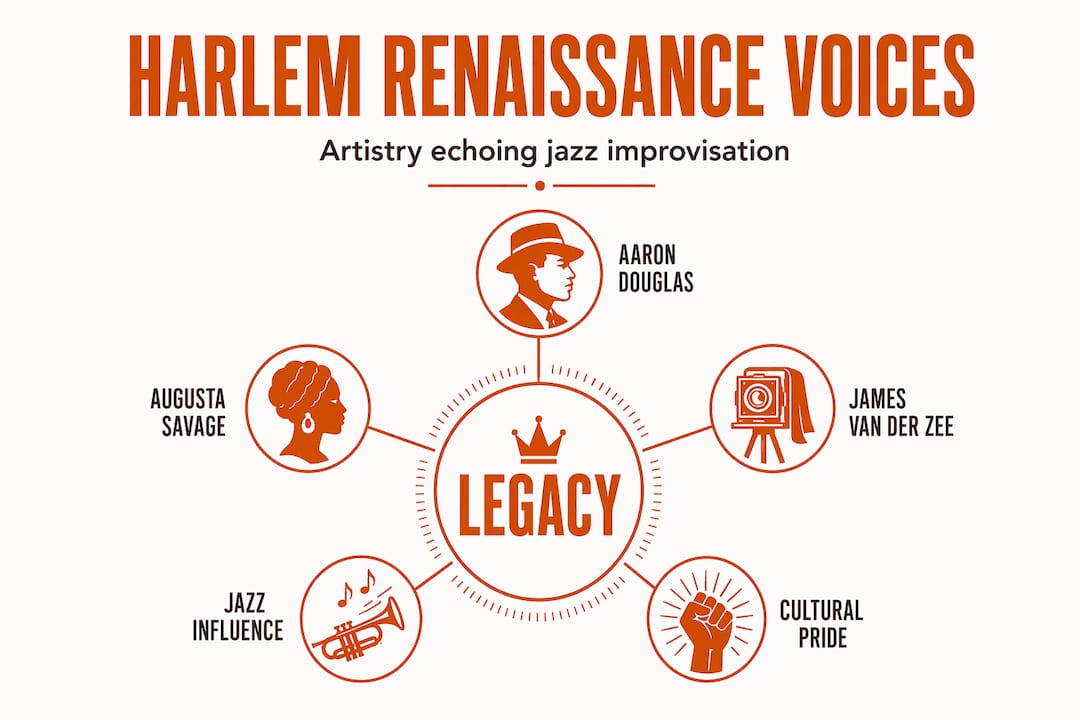
Aaron Douglas is the most direct visual parallel to a jazz soloist. His murals and illustrations use silhouette and geometry to create images that feel both ancient and urgently modern. His work merged African and Egyptian aesthetics with modern urban experience, producing a visual language that had never existed before. Looking at his panels for “Aspects of Negro Life” feels like listening to a trumpet improvise over a blues chord progression. The structure is there. The departure is everything.
Augusta Savage worked in sculpture but her larger contribution was institutional. Her leadership at the Harlem Community Art Center supported over 1,500 people with art training and exhibition opportunities in the late 1930s. She mentored artists like Jacob Lawrence and Norman Lewis, building the ecosystem that allowed the next generation of Black modernists to exist. Think of her as the bandleader who made sure everyone had an instrument and knew how to play it.
It is worth noting that some artists deliberately avoided African motifs to resist being reduced to a single cultural identity. This complexity is important. The movement was not monolithic. Artists negotiated their identities differently, just as jazz musicians developed distinct personal styles within the same genre.
James Van Der Zee brought the jazz ethos to photography. Known as the official chronicler of the Harlem Renaissance, his photographs challenged racist stereotypes by constructing dignified, aspirational images of Black community life. Photography in this era functioned as art, community organizing, and self-representation simultaneously. Van Der Zee was not documenting reality neutrally. He was composing it, the same way a musician composes a solo.
| Artist | Medium | Jazz parallel |
|---|---|---|
| Aaron Douglas | Painting and illustration | Soloist reinterpreting traditional themes through abstraction |
| Augusta Savage | Sculpture and institution building | Bandleader creating the conditions for collective creativity |
| James Van Der Zee | Photography | Composer shaping how the audience hears and sees the story |
The impact of Harlem Renaissance art on Black expression today
The movement’s influence did not stop in the 1930s. The abstraction and cultural reclamation that defined Harlem Renaissance art became the foundation for every major Black art movement that followed. The Black Arts Movement of the 1960s drew directly from it. Contemporary Afrocentric art continues to use the same logic: take a cultural reference point and reinterpret it through a modern lens.
Harlem Renaissance artists focused on real life’s dignity and resilience rather than idealized versions of Black experience. That commitment to truth over comfort was itself a political act. It asserted that Black life was worth portraying with the same seriousness European artists brought to their subjects. That assertion still matters.
The movement also proved that art institutions matter as much as individual artists. Savage’s community center, the exhibitions, the publications like The Crisis and Opportunity that published Black visual art: these created infrastructure that made sustained creativity possible. Without that infrastructure, individual genius goes unheard.
Pro Tip: If you want to understand a contemporary Black artist’s work, trace their influences back through the Harlem Renaissance. The visual vocabulary they are using almost always has roots there, whether they are working in abstraction, portraiture, or digital media.
My take on the jazz-canvas connection
I have spent years thinking about the relationship between music and visual art, and the jazz-to-painting parallel in the Harlem Renaissance is the most precise I have ever encountered. It is not a loose metaphor. It is a structural description of how these artists actually worked.
What strikes me most is that both jazz improvisation and Harlem Renaissance painting were acts of resistance disguised as celebration. When Armstrong bent a note past what European classical training said was acceptable, he was rejecting a system that had defined Black music as inferior. When Douglas abstracted an African motif into geometric silhouette, he was doing the same thing on canvas. The focus on real life over idealization was a deliberate political stance against systemic racism, not just an aesthetic preference.
What contemporary artists and enthusiasts can learn from this is that the most powerful creative work often happens at the intersection of deep cultural knowledge and willingness to break the rules of that culture. You have to know the melody before you can improvise over it. The Harlem Renaissance artists knew their history. That is exactly why their departures from it were so precise and so powerful.
— Robert
Own a piece of this cultural legacy
The Harlem Renaissance was not just a historical moment. It was a philosophy of creative freedom that still shapes how Black artists work today. At Melaninart, we have built a collection that honors that philosophy directly. Our Harlem Renaissance art prints are museum-grade reproductions of original paintings that capture the jazz-inspired modernism, geometric abstraction, and cultural depth that defined the movement. Each piece is created from an original oil or watercolor painting by artist Robert Lawrence, printed on archival materials built to last. Whether you are drawn to the bold silhouettes of the Douglas tradition or the community portraiture of the Van Der Zee era, you will find work in our collection that connects you to this history in a way that lives on your wall every day. Explore the full Afrocentric art collection to find the piece that speaks to you.
FAQ
What time period does Harlem Renaissance art cover?
Harlem Renaissance art spans from approximately 1918 to the late 1930s, coinciding with the Great Migration of Black Americans from the rural South to Northern cities, particularly Harlem in New York.
Who are the most famous Harlem Renaissance artists?
Aaron Douglas, Augusta Savage, and James Van Der Zee are among the most recognized figures. Douglas is known for geometric abstraction and African motifs, Savage for sculpture and institutional leadership, and Van Der Zee for photographic documentation of Black community life.
How did Harlem Renaissance art influence modern Black artistic expression?
The movement established a visual language of cultural reclamation and abstraction that directly influenced the Black Arts Movement of the 1960s and continues to shape contemporary Afrocentric and Afrofuturist art today.
What made Harlem Renaissance art modernist rather than traditional?
These artists took African and historical motifs as reference points and then abstracted them using geometric forms, silhouette, and layered symbolism, breaking from European classical composition in the same way jazz musicians broke from classical music structures.
Where can I find Harlem Renaissance art prints for my home?
Melaninart offers a curated collection of Harlem Renaissance canvas prints reproduced from original paintings, available in multiple sizes with customizable framing options.